Two carriers return similar prices for a US and Canada load. One includes only the transport, while the other also includes an appointment service and a separately priced customs-provider service. Comparing the headline totals will not tell you which offer covers your customer's request.
A cross border trucking quote checklist separates the transport price, customs services, government charges and customer responsibilities. It also records which shipment details and documents are confirmed before you promise a service or send a customer offer.
Use this guide to check a northbound or southbound trucking RFQ, assign ownership of open items and compare offers on the same scope. The worked example shows how two different headline prices can produce the same comparable service total without pretending that every import cost is known.
Key Takeaways
Separate linehaul, fuel, accessorials, customs-provider fees and government charges instead of treating one total as complete.
Identify the importer and customs contact for the destination country before confirming the clearance plan.
Check document readiness and the carrier's information requirements independently from rate availability.
Compare offers in the same currency with matching service inclusions and explicit exclusions.
Define delay triggers, approval contacts and revised-schedule procedures before the truck encounters a hold.
What Should a Cross-Border Trucking Quote Cover?
A cross-border trucking quote should state the transport scope and identify the other services, charges and responsibilities needed for the proposed move. A door-to-door transport description alone does not explain who handles customs work or pays duties and taxes.
Start with separate charge groups:
Group | What to confirm |
|---|
Transport | Equipment, route, pickup, delivery, fuel treatment and carrier handoffs |
Accessorial services | Appointments, additional stops, handling and any agreed waiting terms |
Customs-provider services | Named provider, specific work, fee basis and payer |
Government charges | Who determines and pays applicable duties, taxes or other assessed charges |
Exceptions | Inspections, holds, storage or changed instructions, with agreed charging conditions |
Ask what each provider means by “border fee” or “clearance included.” Replace a broad label with the named service, amount or calculation basis and the party performing the work.
Tip: Give every quoted line one of three statuses: included in the stated total, separately payable, or conditional. Keep amounts that have not been established marked pending rather than entering zero.
Freitt's road freight quoting workflow uses your equipment, lane and accessorial rate sources to prepare a draft. Your team must still define the cross-border scope and obtain the customs-provider information needed for the offer.
Confirm the Route and the Responsible Parties
Confirm the movement direction, actual facilities and responsible parties before matching the request to a rate. Northbound and southbound shipments need their own destination-country review; reversing a lane does not confirm that the same customs setup applies.
Step 1: Record the Complete Transport Request
Capture full addresses, ZIP and postal codes, cargo-ready dates, site hours, appointment requirements and loading arrangements. Include packaged dimensions, gross weight, handling-unit count, commodity and special equipment needs.
Record a preferred crossing if one has been requested, but have the carrier confirm the proposed route. Ask about direct service, transfer points and any handoff that could affect timing or the transport price.
Step 2: Name the Importer and Customs Contact
Record the importer identity and the customs provider responsible for the destination-country work, or mark the arrangement pending. Keep their contact details and instructions with the shipment record.
CBSA's licensed customs broker guidance explains that importers using an agent retain responsibilities for their import transactions and that brokerage fees are a private commercial arrangement. Naming a freight broker or paying a transport invoice does not, by itself, identify the authorized customs provider.
Step 3: Confirm Who Buys and Pays for Each Service
Ask whether the customer, consignee, shipper or your business is arranging the customs work. Document the provider's scope and commercial authorization rather than assuming the receiver will handle it.
If the customer supplies a trade term, include its named place and ask the relevant parties to resolve unclear responsibilities. Do not use a short trade-term abbreviation as a substitute for the transport and customs scope on your offer.
Check Document Readiness Before Promising Timing
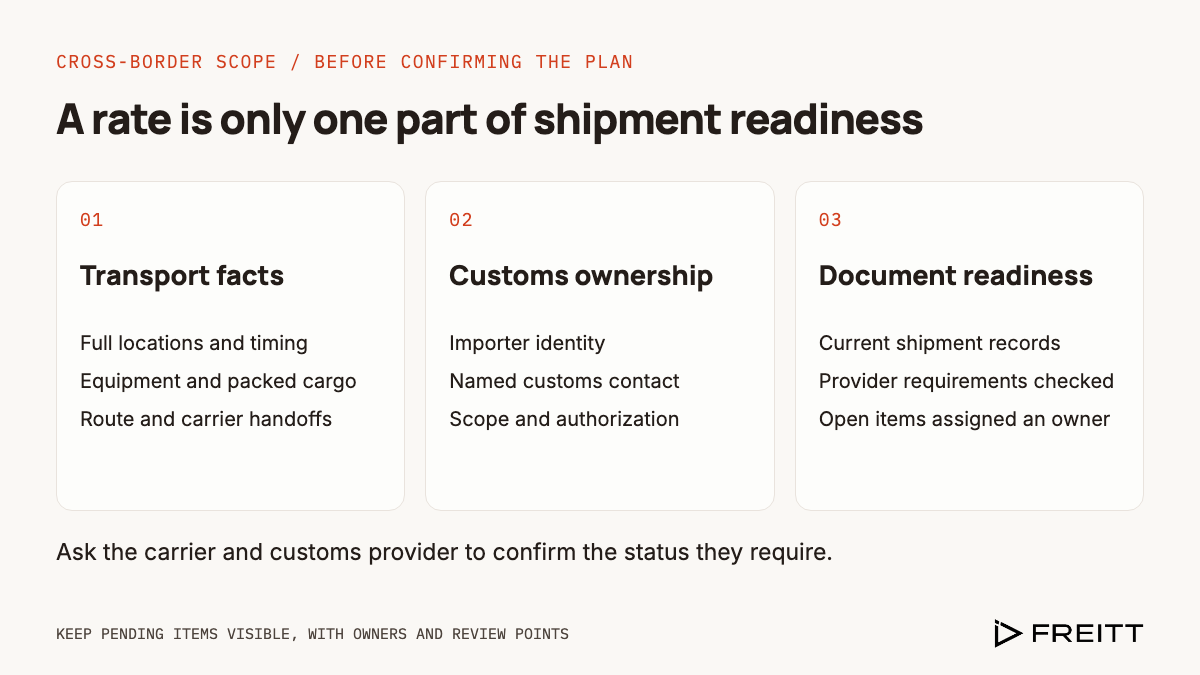
Check whether the responsible parties have the required information and can complete their work for the proposed schedule. A transportation rate can be available while essential customs details remain unresolved.
Step 1: Assemble the Shipment Information
Request the current commercial invoice, packing details, transport references and the customs provider's instructions. Ask the specialist to identify any additional certificates, permits or product information required for this shipment.
Compare descriptions, quantities, weight, parties and currency across the records. A packing list and RFQ that disagree on the number of handling units need clarification before you price or plan the wrong load.
For US-bound merchandise, 19 CFR 141.86 invoice requirements address details including descriptions, quantities, price or value information, currency and country of origin. Have the responsible importer or customs provider confirm the complete applicable requirements; a short internal checklist does not replace that review.
Step 2: Check Canada-Bound Importer Readiness
For goods entering Canada, confirm the importer's setup with the responsible customs contact. CBSA's business setup guidance describes CARM registration, import-program accounts and delegation to a customs broker, with separate guidance on release and payment arrangements.
Record whether the necessary setup and authorization have been confirmed, by whom and when. Do not label a shipment ready merely because the customer has used a customs broker previously.
Step 3: Confirm Origin and Product Questions
Keep the shipping location separate from the goods' country of origin. If preferential treatment is requested, ask the responsible specialist to confirm eligibility and supporting information rather than assuming a US or Canadian pickup address establishes it.
Trade.gov's USMCA resources provide links to rules of origin and certification guidance. Ask the importer or customs provider to determine the treatment for the actual goods, transaction and import date before including any duty estimate in your commercial offer.
Note: Ask the carrier and customs provider which information must be accepted before the planned crossing and who confirms that status. A document being emailed is different from the relevant party confirming it is usable.
Worked Example: Compare Offers on the Same Scope
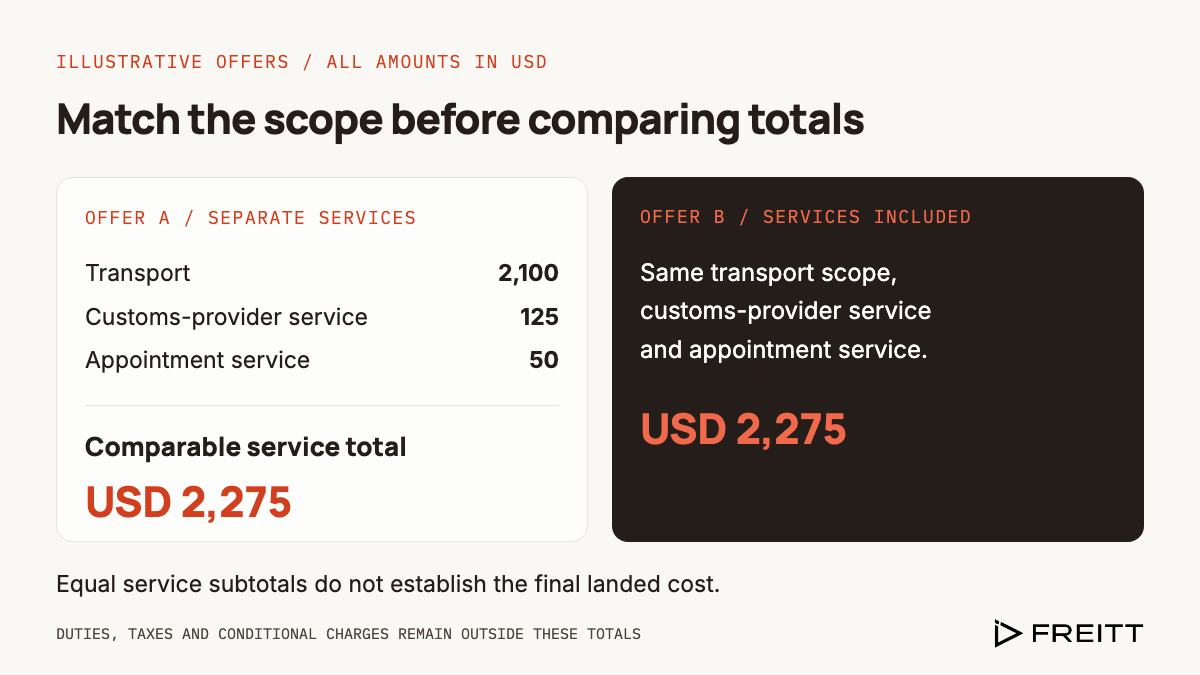
This fictional example compares a proposed US-to-Canada move. The amounts are invented to demonstrate scope matching, not market rates, government fees or a customs-provider tariff.
Assume both offers cover the same confirmed cargo, equipment, route and transport conditions, with all amounts in USD. Your customer also requests a delivery appointment service and a specific customs-provider service that has been separately confirmed for this example.
Cost item | Offer A | Offer B |
|---|
Linehaul | USD 1,800 | USD 1,800 |
Fuel | USD 300 | USD 300 |
Confirmed customs-provider service | Separate, USD 125 | Included, USD 125 |
Delivery appointment service | Separate, USD 50 | Included, USD 50 |
Stated offer total | USD 2,100 | USD 2,275 |
Step 1: Add the Same Requested Services
Offer A's transport total is USD 1,800 + USD 300 = USD 2,100. Adding the separate USD 125 service and USD 50 appointment gives a comparable service total of USD 2,275.
Offer B already includes those services at USD 2,275. On this defined service basis, the offers are equal, even though the first headline total appears lower.
Step 2: Preserve the Remaining Exclusions
Assume neither offer includes duties, taxes, inspections, storage or eligible waiting charges. Those items remain separately identified and are not set to zero in the comparison.
The USD 2,275 figure is therefore a comparable service subtotal, not the shipment's final landed cost. Identify who will establish the remaining amounts and how any conditional transport extras will be approved.
Step 3: Check Currency and Payment Terms
Confirm the settlement currency and payer for each line. If a separate service is quoted in CAD, do not add it directly to a USD total. Document the agreed conversion basis, date and any conversion fee before making a combined comparison.
Tip: Keep the original offers beside your comparison. Ask the provider to confirm every added service and its conditions before you describe it as included in your customer-facing total.
Define Delay Charges and Schedule Changes
Define the conditions for additional charges and the process for schedule changes before the truck moves. A border-related delay does not automatically establish the same waiting charge under every carrier agreement.
Record the applicable allowance, start and end events, billing unit, currency and evidence requirements. Ask who receives notice, who may authorize additional work and when a revised plan needs approval.
Separate these possible events in the load record:
The carrier is waiting for documents before pickup.
The truck has arrived at a facility and cannot proceed.
A customs examination or other hold changes the plan.
The receiver's appointment must be changed.
Storage, another stop or revised transport is requested.
For each event, refer to the actual agreement and provider confirmation. Avoid a blanket statement that all delay costs are included or that every additional cost can be passed to the customer.
Further reading: Use the FTL detention quote terms guide to define waiting allowances and evidence without assuming a universal rate.
Also distinguish a transit estimate from a confirmed appointment or service commitment. If readiness or release remains unresolved, state what must happen before the schedule can be confirmed.
Use a Final Cross Border Trucking Quote Checklist
Use this final check to connect your confirmed transport scope with the customs and document responsibilities. Give every open item an owner and a review point.
Complete locations, equipment, cargo and handling requirements match the RFQ.
The movement direction, proposed route and carrier handoffs are understood.
Importer identity and the destination-country customs contact are recorded.
The specialist has identified document, product and authorization requirements.
Transport, provider services and government charges are separately described.
Included, separate, conditional and pending amounts are visible.
Currency, fuel treatment, validity and payment responsibilities are explicit.
Delay notices, approval contacts and schedule-change procedures are documented.
Use the trucking RFQ checklist for the underlying load details. Keep the cross-border record as an additional scope check, not a replacement for measuring the packed cargo or confirming both sites.
Freitt's email-to-quote workflow reads forwarded requests and attachments and raises missing or ambiguous details. Your team reviews the draft and supplies the verified customs-provider scope; the workflow does not replace that provider's review or authorization.
FAQs
Does a cross-border trucking quote include customs brokerage?
A cross-border trucking quote includes customs-provider services only when the offer explicitly identifies them as included. Ask which provider performs the work, what the service covers and who pays it. Keep provider fees separate from duties and taxes, and confirm exclusions before treating a transport total as the complete shipment cost.
What information should you send for a US and Canada trucking quote?
Send the full locations, timing, cargo measurements, weight, count, equipment and site requirements, plus importer and customs-contact details when established. Include document readiness and any known product questions. Mark unresolved facts pending so the carrier and customs provider can identify what affects pricing, service suitability and the proposed schedule.
Is CARM readiness relevant to a Canada-bound trucking quote?
CARM readiness is relevant when planning the commercial import arrangement for goods entering Canada. Ask the importer and customs provider to confirm the necessary registration, accounts, delegation and release or payment arrangements for the shipment. A transport rate can still be discussed while items are pending, but that does not establish readiness to cross.
Are goods picked up in Canada automatically eligible for preferential duties?
A Canadian pickup address does not by itself establish eligibility for preferential treatment. The relevant rules concern the actual goods and transaction, including origin requirements and supporting information. Ask the importer or customs provider to confirm the applicable treatment, and do not put an unsupported duty assumption into your trucking offer.
How do you compare trucking offers in USD and CAD?
Compare USD and CAD offers using an agreed currency basis and conversion method after matching their service scope. Record the conversion date, payer and any fees, and retain the original amounts. Do not add a CAD customs-provider fee directly to a USD transport price or assume the provider will settle in your preferred currency.
Does a quoted transit time guarantee customs release?
A quoted transport transit estimate does not guarantee customs release. Confirm what the carrier's stated service covers and which readiness conditions remain open. Keep release status, transport scheduling and receiving appointments distinct, then record how the parties will communicate a hold or revised delivery plan before promising a specific arrival commitment.
Prepare a Cross-Border Offer Your Customer Can Check
Build the offer from a confirmed load record, a named customs contact and an itemized scope. Compare the same services, preserve the exclusions and resolve the open questions before turning a transport estimate into a customer commitment.
Bring that RFQ and your approved rate sources to see how Freitt prepares a quote draft your team reviews and sends.