Your carrier quote includes detention after free time, but nobody has confirmed when that clock starts. The truck arrives early, unloading runs late, and your customer reads the allowance differently from your carrier.
FTL detention quote terms define the waiting allowance, the event that starts the clock and the conditions for an additional charge. You need those details before you send a customer offer, together with the rate, billing unit and required evidence.
This guide gives your trucking quote desk a practical way to check those terms. You will build a clear detention line, calculate an illustrative charge and handle early arrival, paperwork delays and conflicting records without assuming every carrier uses the same rules.
Key Takeaways
Confirm free time separately for pickup and delivery, including the event that starts each allowance.
Record the detention rate, currency, billing increment, rounding method and any agreed cap.
Keep appointment, check-in, loading completion and release timestamps separate in your evidence.
Match the customer-facing wording to the carrier commitment or obtain approval for the difference.
Use worked calculations to check interpretation before a truck encounters a delay.
What Are FTL Detention Quote Terms?
FTL detention quote terms describe how waiting at a pickup or delivery facility can become an additional transport charge. For a live loading or unloading appointment, they should explain the included allowance and how eligible waiting beyond that allowance is priced.
Do not treat a detention note as a complete rule simply because it contains an hourly price. A usable quote needs a start event, an end event and any conditions that affect eligibility.
The charge also needs a clear place in the commercial chain. Your carrier may charge your brokerage or forwarding business, while you recover an agreed charge from your customer. Those are separate commitments that your desk must compare.
Keep these concepts distinct when reviewing the request:
Term | What your desk should establish |
|---|
Free time | Included eligible waiting before a charge begins |
Detention | Additional eligible waiting priced under agreed terms |
Layover | A separately defined extended-delay charge or arrangement |
Trailer detention | Equipment waiting terms that may differ from attended live service |
FMCSA's research on detention and driver fatigue examines safety concerns associated with loading and unloading delays. Your commercial detention calculation should never be used to decide whether a driver can safely continue the trip.
Which Detention Terms Should You Confirm Before Quoting?
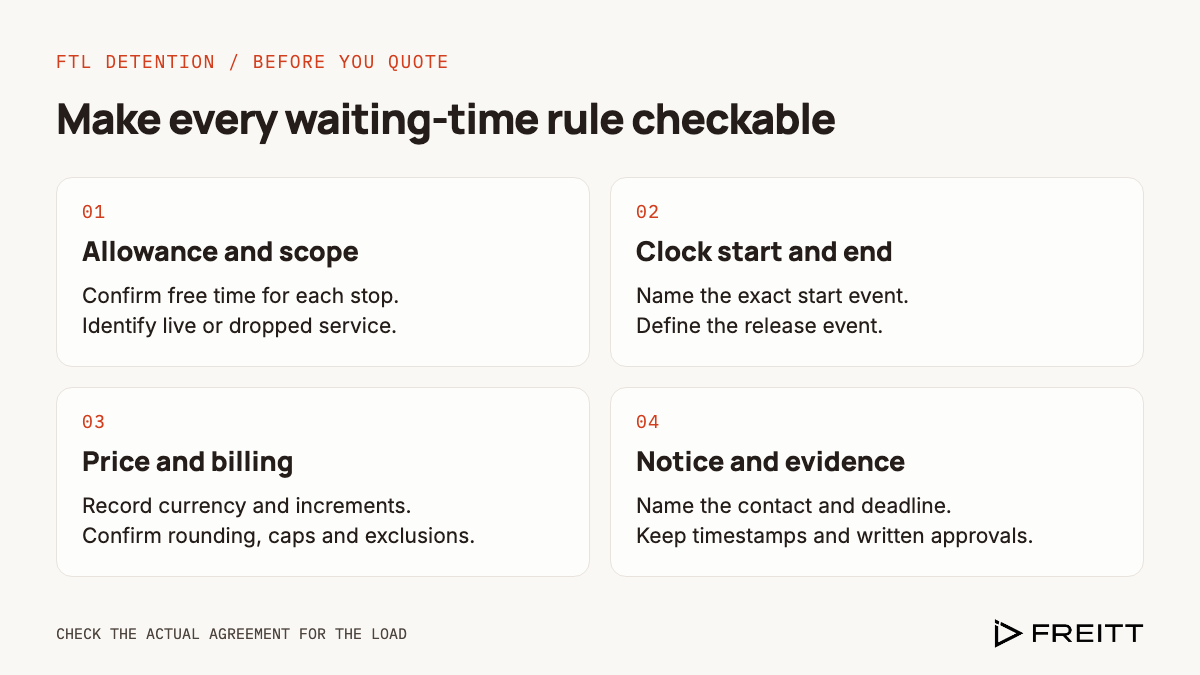
Confirm the allowance, clock events, price and evidence together. Copying one field from an old quote can leave a new load with terms nobody has agreed.
Step 1: Identify the Applicable Service and Stop
Record the carrier, equipment, lane and service type. Confirm whether the move involves live loading, live unloading, a dropped trailer or another arrangement. Build separate pickup and delivery entries when their conditions differ.
Check the governing carrier agreement, load confirmation and applicable tariff or accessorial schedule. If they conflict, obtain written clarification from the authorized parties instead of deciding document precedence yourself.
Step 2: Specify Free Time and Clock Events
State the allowance in minutes or hours and identify its start event. Possible agreement wording might refer to the scheduled appointment, accepted check-in or the later of specified events. Choose the rule actually agreed for this load.
Identify the end event just as carefully. Loading completion, signed paperwork, release and physical gate exit are different timestamps. Do not replace the agreed event with whichever record is easiest to obtain.
Note: A published carrier rule illustrates why assumptions fail. Item 504 in the Dohrn rules tariff effective September 29, 2025 specifies one hour of free time for truckload loading or unloading and uses arrival or appointment time, whichever is later. That is a carrier-specific example, not the allowance for your load; confirm the current applicable version.
Step 3: Define Price and Billing Method
Record the amount, currency and unit. An hourly equivalent does not explain whether billing uses exact minutes, completed increments or each started increment.
Ask about minimum billable time, caps, excluded periods and any transition to another charge. For US and Canada work, write USD or CAD explicitly rather than leaving a dollar sign open to interpretation.
Step 4: Confirm Notice, Approval and Evidence
Write down who must receive notice, how it must be sent and when it is due. Distinguish notification of a delay from authorization of an additional charge.
Add the required documents and submission deadline to the load record. The CTAC guide to documenting accessorial charges recommends recording the appointment, check-in, work progress and release, with timely written notice and supporting records.
How Do You Write a Clear Detention Line?
Write a detention line that another operator can apply without calling the person who prepared it. Keep the commercial wording readable, with detailed instructions in the linked load record.
Use this field order as an internal drafting template:
Stop and service: Name the pickup or delivery facility and live-service arrangement.
Allowance: State included free time and its start event.
Charge: State currency, amount, billing increment and rounding rule.
End event: Identify when eligible waiting stops.
Conditions: State arrival eligibility, excluded periods, caps and transition rules.
Administration: Identify notice recipient, approval contact, evidence and submission deadline.
For example, your draft might say: “Live unloading at the named receiver includes 120 minutes from the later of the scheduled appointment or accepted check-in. Additional eligible waiting is USD 20 per started 15-minute increment until the agreed release event.”
That wording is illustrative and incomplete until you add the actual arrival conditions, notice process, release definition and any exclusions. Have your authorized commercial owner approve the final terms against the carrier commitment.
Freitt's road freight quoting workflow supports equipment, lane pricing and accessorials from your own rate sources. Your team still needs to supply and review the applicable detention conditions; a rate amount alone cannot settle an ambiguous clock rule.
Tip: Store the source document, version and effective dates alongside the charge. You can then show why the quote used that rule when a customer asks about it later.
Worked Example: Calculate Eligible Waiting and Billing Units
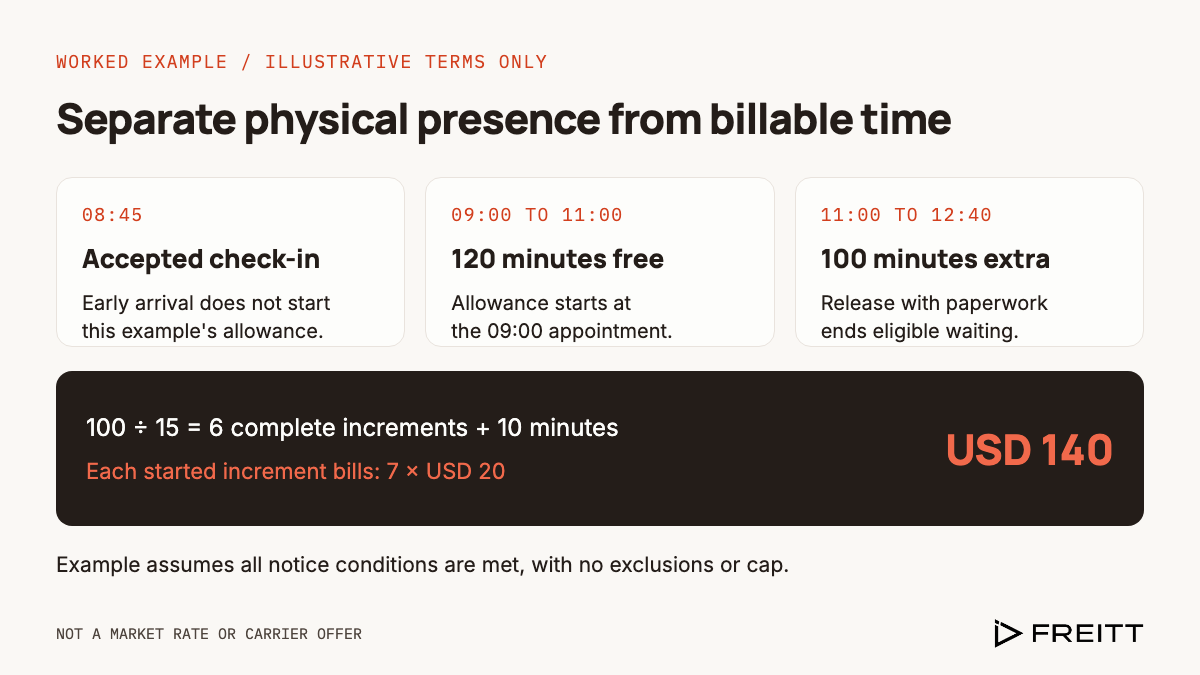
This example uses invented agreement terms to demonstrate the calculation. The allowance and amounts are not market benchmarks, statutory requirements or a carrier offer.
Assume the agreed terms for one live unloading stop are:
Appointment: 09:00, facility local time.
Accepted check-in: 08:45, with the agreed arrival conditions satisfied.
Free time: 120 minutes from the later of appointment or accepted check-in.
End event: release with completed paperwork, recorded at 12:40.
Billing: USD 20 for each started 15-minute increment beyond free time.
The example has no excluded periods or cap, all notice requirements are satisfied and no layover charge applies.
Step 1: Establish the Eligible Start
The later of 09:00 and 08:45 is 09:00. The early arrival does not consume the allowance under this example's rule.
Step 2: Subtract Free Time
The period from 09:00 to 12:40 is 220 minutes. Subtracting the 120-minute allowance leaves 100 minutes of eligible detention, beginning at 11:00.
Step 3: Apply the Agreed Billing Increment
Divide 100 minutes by 15 to get six complete increments plus ten minutes. Because the example bills each started increment, you bill seven increments: 7 × USD 20 = USD 140.
Now test how another agreed billing method would change the result:
Illustrative method | Billable basis | Example charge |
|---|
Each started 15 minutes | Seven increments at USD 20 | USD 140 |
Completed 15 minutes only | Six increments at USD 20 | USD 120 |
Exact minutes at USD 80/hour | 100 minutes divided by 60 | USD 133.33 |
Only one method should govern the actual load. Do not select the largest result after the delay occurs.
Notice that the truck was physically present for 235 minutes, from 08:45 until 12:40. Billing all that time would ignore the agreed start event and overstate the charge. Keeping both physical presence and eligible waiting in the record makes the calculation checkable.
How Should You Handle Exceptions and Conflicting Records?
Handle exceptions by returning to the agreed rule and the recorded events. A difference in timestamps is a reason to investigate, not an invitation to choose whichever number supports your invoice.
Early Arrival, Late Arrival and Appointment Changes
An early truck may wait before its allowance begins, depending on the agreement. A late truck may face different eligibility conditions. Do not apply the example's later-of rule unless the actual agreement uses it and its other conditions are satisfied.
If the appointment changes, retain the original booking, the revised time and the written acceptance. Ask which appointment governs the calculation before issuing a revised offer or accepting an additional charge.
Finished Unloading but Waiting for Paperwork
Record unloading completion and release separately. If unloading finishes at 12:10 but completed paperwork is released at 12:40, the agreed end event determines which timestamp belongs in the calculation.
Capture who provided each time and how it was recorded. A signed delivery receipt, gate record and carrier message may describe different events rather than contradict one another.
Delay Continues into Another Service Period
Check whether a cap, layover arrangement or other rule replaces hourly detention. Confirm the transition time and whether charges overlap. Do not add a full layover amount to ongoing detention unless the agreement supports that treatment.
Freitt's rate-sheet automation preserves source and calculation traceability for quote preparation and flags missing or expired rates. That helps your reviewer check the pricing source; it does not replace operational timestamp collection or determine whether a detention claim is payable.
What Should Your Desk Check Before Sending the Quote?
Check that your customer-facing detention terms match what your business has agreed to buy. If they differ, identify who approved the exposure and where that decision is recorded.
For example, promising a customer three free hours while accepting a carrier's two-hour allowance creates potential cost exposure. Do not assume a general margin percentage will cover an undefined delay.
Use this final review checklist:
The correct stop, equipment and live or dropped service are identified.
Pickup and delivery allowances are stated separately where needed.
Start and end events are explicit and use the relevant time zone.
Currency, increment, rounding, exclusions and any cap are documented.
Notice, authorization and evidence requirements have named owners.
Carrier and customer terms have been compared and differences approved.
The current source and written clarification are attached to the load record.
Further reading: Use the truckload rate-per-mile comparison guide to compare the full scope of carrier offers alongside their waiting-time conditions.
FAQs
When does FTL detention start?
FTL detention starts when eligible waiting exceeds the free time defined in the applicable agreement. First identify when the allowance begins, then add its duration. Appointment time, accepted check-in and physical arrival may be different events, so retain all three and apply the actual written rule rather than assuming they are interchangeable.
Does every carrier include two hours of free time?
You should not assume every carrier includes two hours of free time. Check the allowance for the specific carrier, service and stop, including any customer agreement that changes the published terms. If your source is missing or unclear, request confirmation before sending the quote instead of copying an allowance from a previous load.
How do you calculate truckload detention charges?
Calculate truckload detention by measuring the eligible period, subtracting the agreed allowance and exclusions, then applying the specified billing method. Confirm whether the agreement uses exact minutes, completed increments or each started increment. Check any minimum, cap or transition rule before multiplying by the rate, and show the calculation beside its supporting timestamps.
What proof should you keep for a detention charge?
Keep the applicable terms, appointment confirmation, arrival and check-in records, the agreed end-event record and required notices or approvals. Match every item to the load and stop. If the facility cannot sign a time record, follow the agreed escalation process and preserve alternative evidence without representing an unconfirmed timestamp as a verified fact.
Is detention the same as layover?
Detention and layover are separate charge concepts whose triggers depend on the agreement. Detention commonly concerns eligible waiting beyond an allowance, while layover addresses an extended delay under separately defined terms. Confirm when one treatment replaces another, what amount applies and whether any overlap is allowed before quoting or accepting additional costs.
Can you pass every carrier detention charge to your customer?
You can recover a carrier detention charge from your customer only to the extent supported by your customer agreement and the circumstances. Compare the two commitments before sending the quote. A carrier invoice alone does not establish that your customer accepted the same allowance, billing increment, evidence requirements or additional-charge approval process.
Prepare a Detention Quote Your Team Can Check
Start with one carrier agreement and one real RFQ. Confirm the clock events, allowance, billing method and evidence requirements, then test your wording against an early-arrival and delayed-release example before sending it.
Bring those source documents to see how Freitt prepares a reviewable quote from your approved rates. Your team reviews and sends the customer response. Book a Demo.