A carrier offers $2.40 per mile. Another offers $2.55. Before you choose the lower number, check what each offer includes and which mileage it uses. Fuel, stop charges and a different route basis can reverse the result.
Truckload rate per mile is a stated freight amount divided by a stated number of miles. To compare carrier quotes, use the same shipment scope, currency and mileage basis, then account for the same included charges.
This guide shows you how to calculate the rate, compare two illustrative carrier offers and separate a quote-desk comparison from a carrier's revenue calculation. You'll also get a checklist you can use before preparing the customer quote.
Key Takeaways
Define both the charges and the mileage behind every rate-per-mile figure.
Compare linehaul with linehaul, or comparable quoted totals with comparable quoted totals.
Check fuel and accessorial terms before treating an offer as the cheaper option.
Use total operating miles for a carrier revenue check, while keeping the quote comparison's mileage basis consistent.
Keep carrier buy cost separate from the customer sell price and retain the original source.
What Is Truckload Rate per Mile?
Truckload rate per mile expresses a freight amount for each mile in a defined movement. The formula is simple, but the label is incomplete unless you know what money and distance went into it.
A quote desk may compare carrier buy offers per loaded mile. A carrier may divide expected revenue by loaded miles plus empty repositioning miles to assess a load. Those calculations answer different questions, so label them separately.
Measure | Calculation | What it helps you check |
|---|
Linehaul per loaded mile | Linehaul amount ÷ loaded miles | Base transportation pricing before separately quoted charges |
Comparable quoted total per loaded mile | Linehaul, fuel and agreed included extras ÷ loaded miles | Carrier offers for the same confirmed scope |
Carrier revenue per total mile | Expected load revenue ÷ loaded and attributed empty miles | Revenue spread across the carrier's planned driving |
“All-in” needs a scope check. It may mean fuel is included, while detention, extra stops or other conditional services remain additional. Ask what the offer covers rather than assuming the phrase settles every charge.
How Do You Calculate Truckload Rate per Mile?
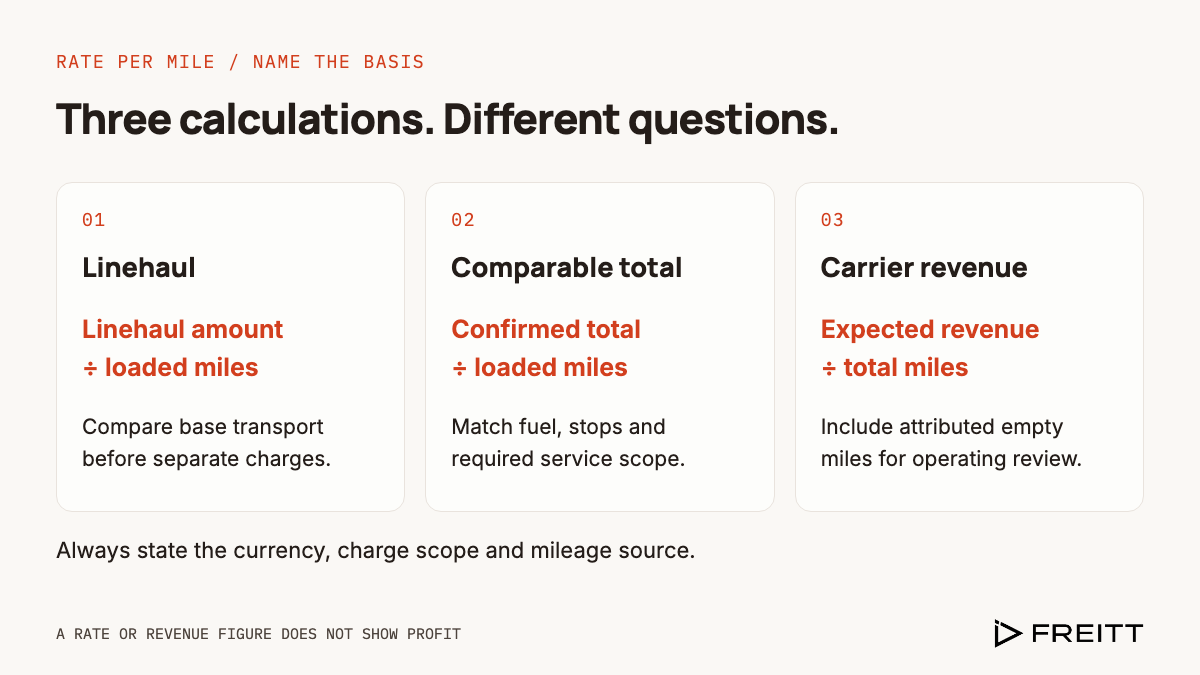
Divide the selected freight amount by the corresponding mileage, keeping the units explicit. For a carrier-offer comparison, first calculate the total for the services you actually need.
Step 1: Confirm the Load and Equipment
Record pickup and delivery locations, shipment date, trailer type, cargo weight and required service. A standard dry van offer is not directly comparable with an offer that includes specialized equipment or a tighter delivery commitment.
Check stops, appointment requirements and loading responsibilities too. If one carrier has priced different instructions, resolve that difference before ranking its offer.
Step 2: Agree on the Mileage Basis
Identify whether the carrier used practical route miles, a specified routing system or another agreed distance. Save the basis beside the rate so a colleague can reproduce the result.
If you receive a binding flat offer, you can divide it by a common reference mileage for comparison. That does not change the carrier's quoted total. If you receive a per-mile offer, confirm the payable miles before calculating the amount due.
Step 3: Separate the Charge Components
List linehaul, fuel and known accessorials separately when the offer provides that breakdown. For a bundled offer, record which items the carrier confirms are included.
Do not add fuel again to a fuel-inclusive offer. Do not insert a made-up amount for an unknown charge just to complete a spreadsheet.
Step 4: Calculate Without Early Rounding
Suppose an illustrative offer totals $1,825 for 650 agreed loaded miles. Its comparable rate is $1,825 ÷ 650 = approximately $2.81 per loaded mile.
Keep the original dollar total and full calculation precision in your working file. Round the displayed rate at the end. Multiplying a rounded display rate back by mileage may produce a slightly different total.
Step 5: Check the Original Terms
Confirm validity, capacity conditions, included services and exclusions against the carrier's source email or rate sheet. A neat calculation does not make an expired offer usable.
Freitt's road-freight quoting workflow uses equipment, lane, zone or distance information with sheet-defined charges. Your team still needs an applicable approved source and a person to review and send the resulting quote.
Worked Example: Compare Two Carrier Quotes on the Same Basis
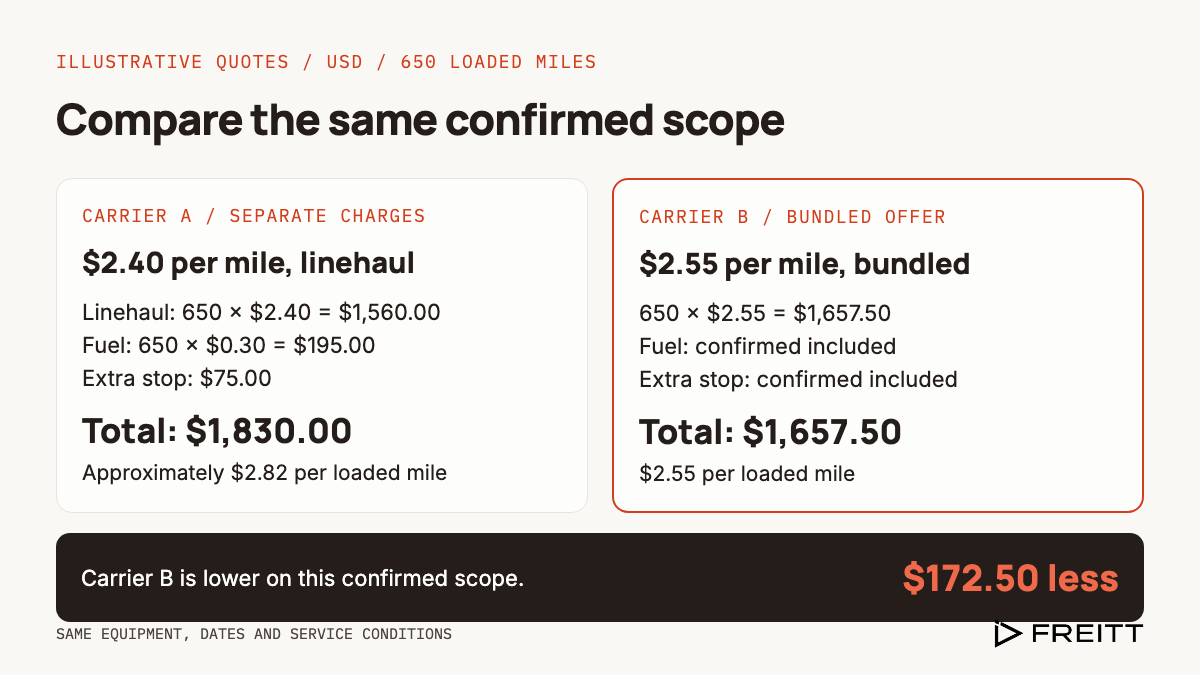
Example: You need a dry van movement covering 650 agreed loaded miles, with one extra delivery stop. Both illustrative offers use USD, the same equipment and dates, and the same appointment and detention conditions. The figures below are teaching examples, not live market rates.
Carrier A offers lower linehaul but quotes fuel and the stop separately. Carrier B offers a higher per-mile figure that includes both items.
Quote component | Carrier A | Carrier B |
|---|
Stated per-mile offer | $2.40 linehaul only | $2.55 including fuel and one extra stop |
Linehaul calculation | 650 × $2.40 = $1,560.00 | Included in bundled amount |
Separate fuel charge | 650 × $0.30 = $195.00 | Included |
One extra stop | $75.00 | Included |
Comparable quoted total | $1,830.00 | 650 × $2.55 = $1,657.50 |
Comparable total per loaded mile | Approximately $2.82 | $2.55 |
Check the Difference in Dollars
Carrier A's comparable amount is $1,560 + $195 + $75 = $1,830. Carrier B's amount is $1,657.50. On this confirmed scope, Carrier B is $172.50 lower, despite the higher headline per-mile figure.
If you compared only the stated rates, you would miss the fuel and stop charges. The useful result is the confirmed total for the required service, with the per-mile figure as a supporting comparison.
Hold the Decision When Scope Is Unclear
Now change one assumption: Carrier B has not confirmed the extra stop. Its offer is no longer fully comparable. Mark the stop as unresolved and ask for a revised or clarified offer.
You can show a clearly labeled internal scenario, but do not present an assumed charge as the carrier's price. Confirm equipment availability and the service commitment before choosing either carrier.
Tip: Add a “confirmed included,” “additional” or “unresolved” field beside each requirement. A blank cell should never silently mean free.
Which Fuel and Accessorial Charges Belong in the Comparison?
Include charges that apply to the agreed comparison scope, using the carrier's terms. Keep possible event-based charges visible as conditions rather than pretending they have already occurred.
For fuel, record whether the amount is bundled, per mile or calculated from an agreed schedule. If a schedule applies, save its reference period, effective date, base and calculation method.
The EIA's explanation of diesel fuel surcharges makes clear that the agency does not set or regulate them. An EIA diesel price is an input some agreements reference, not an automatic surcharge you can apply to every load.
The OOIDA fuel surcharge calculator illustrates how fuel-price changes and fuel economy can be used in a calculation. Your actual comparison must follow the accepted agreement, including any specified rounding or schedule rules.
Check accessorial scope with questions such as:
Is the extra stop included, and does the stop order match the request?
Who pays unloading or lumper charges, and what evidence is required?
What waiting-time allowance and charge trigger apply?
Are tolls or route-specific costs included or separately agreed?
Does the quoted service require equipment or handling not yet priced?
Freitt's rate-sheet automation keeps rate, charge and validity information connected to its source. Missing or expired rates are flagged rather than invented, which helps your reviewer identify a comparison that still needs clarification.
Note: A comparable quoted total is not a promise that no later charge can arise. State the conditions that can change the final invoice.
How Do Empty Miles and Operating Costs Change the Carrier's View?
Empty miles change a carrier's revenue-per-total-mile calculation. They do not automatically change the mileage a customer or broker agreed to pay.
Example: A carrier receives $1,800 for a 600-loaded-mile trip and attributes 100 empty pickup miles to that load. Revenue per loaded mile is $1,800 ÷ 600 = $3.00. Revenue per total mile is $1,800 ÷ 700 = approximately $2.57.
Neither figure is profit. To assess profitability, compare revenue with the carrier's applicable operating costs and time commitments. Fuel, maintenance, driver compensation, equipment costs and empty running must be treated consistently in the analysis.
For a quote desk comparing buy offers, use a common agreed reference distance. For a carrier evaluating the work, keep a separate total-mile and time assessment. Avoid calling both numbers simply “RPM” in the same worksheet.
Use these labels to keep the distinction clear:
Carrier buy total: the amount payable for confirmed scope.
Comparison mileage: the common distance used to evaluate offers.
Carrier operating mileage: the loaded and attributed empty distance used internally.
Customer sell total: your offer after applying approved pricing rules.
Further reading: The existing freight quote template guide explains how to separate private costing from the customer-facing offer.
What Should You Check Before Choosing a Carrier Offer?
Choose only after price and service scope are comparable. A low rate cannot resolve an unsuitable trailer, unconfirmed capacity or a delivery requirement the offer does not cover.
Use this final review checklist:
Match lane direction, locations, equipment, cargo and dates.
Confirm both currency and distance units, especially on US and Canada work.
Label the mileage source and verify any per-mile extension.
Record fuel treatment and each required accessorial.
Separate confirmed costs from conditional or unresolved items.
Check validity and any availability conditions.
Preserve the source offer and the person who reviewed it.
Apply customer pricing separately from the carrier comparison.
Market reports can provide context, but they do not replace a load-specific offer. DAT's explanation of spot and linehaul rate reporting distinguishes negotiated fuel-inclusive spot pricing from linehaul figures with an estimated fuel component removed. Check the report's basis before comparing it with your worksheet.
Keep one row per carrier offer and one consistent set of shipment requirements. When details change, preserve the original and compare revised offers against the updated scope.
FAQs
How do you calculate truckload rate per mile?
Divide the selected freight amount by the stated mileage. For a loaded-mile quote comparison, use the agreed loaded distance and a total that covers the same confirmed services across offers. Identify whether fuel and extras are included. Save both the original amount and the mileage basis so another reviewer can reproduce the calculation.
Does a truckload rate per mile include fuel?
It includes fuel only when the carrier's offer or applicable agreement says so. Some quotes bundle fuel into a total, while others show a separate charge or schedule. Ask for clarification if the label is unclear. Adding a surcharge to an already fuel-inclusive amount would count the same component twice.
Should you include deadhead miles when calculating rate per mile?
Include attributed deadhead when assessing a carrier's revenue per total operating mile. For a customer or broker quote comparison, use the agreed pricing or reference mileage and label it clearly. Do not silently add empty miles to a payable distance. Keep the carrier's operating analysis separate from the quoted billing basis.
What is a good truckload rate per mile?
A good rate is one that fits the actual lane, equipment, dates, service requirements and business economics. No single number answers that for every load. Use relevant, dated market context alongside confirmed offers. A carrier also needs to evaluate its own costs, empty positioning and time commitments before accepting the work.
Is rate per mile the same as cost per mile?
Rate per mile describes a freight price or revenue amount divided by mileage. Cost per mile describes operating costs divided by the miles included in that cost analysis. Comparing the two is useful only when the distance and cost definitions align. Neither a quoted rate nor a national benchmark proves profit on a specific load.
How do you compare an all-in offer with linehaul plus fuel?
Convert both offers into totals for the same confirmed shipment scope, currency and mileage basis. Add the applicable fuel and known extras to the linehaul-only offer, then verify what the bundled offer includes. Keep conditional services and unresolved charges visible. Compare the dollar totals before rounding the supporting per-mile figures.
Check One Load from Carrier Offer to Customer Draft
A useful rate-per-mile comparison starts with clear scope and ends with a price you can trace. Keep the carrier buy offer, mileage and charge rules together, then apply your customer pricing separately.
Bring one trucking RFQ and its approved rate sheet to see how Freitt prepares a quote draft for human review. Book a Demo.