A freight quote template gives you a repeatable way to show the shipment, service, price and conditions you are offering. A useful version also helps you catch missing information before a customer accepts a price you cannot deliver.
If your desk copies yesterday's email and changes the total, yesterday's assumptions can travel with it. A missed liftgate requirement or an expired carrier rate can turn a straightforward shipment into a margin problem.
Use the copyable format below to build a customer quote, keep buy rates separate, and check the working behind the total. You will also get a worked example and a short review checklist you can use across air, ocean and road shipments.
Key Takeaways
Record the shipment and service scope before you calculate the price.
Show the currency, charge basis, included services and conditional extras clearly.
Keep carrier buy rates and internal margin calculations out of the customer copy.
Set quote validity against the underlying rates and confirm capacity separately.
Check every draft against its source costs before a person sends it.
What Should a Freight Quote Template Include?
A freight quote template should include your reference, customer, shipment details, service scope, itemized price, validity, exclusions and acceptance instructions. Treat it as a record of what you priced, rather than a page containing only a total.
Use these blocks as your minimum starting point:
Quote block | What to record |
|---|
Reference | Quote number, version, issue date and customer RFQ reference |
Parties | Your business details, customer name and contact |
Shipment | Commodity, packaging, pieces, gross weight and packed dimensions |
Route and timing | Collection and delivery points, ready date and requested windows |
Service | Mode, equipment, service boundaries and handling requirements |
Price | Currency, charge descriptions, quantities, units and totals |
Conditions | Validity, exclusions, payment terms and booking conditions |
Acceptance | Reply instructions and the details the customer must confirm |
For LTL, capture the applicable NMFC item and freight class as well. NMFTA's classification guidance explains that density, handling, stowability and liability influence classification, so a commodity description still matters even when you have calculated density.
Tip: Keep a separate field for unresolved questions. An empty field is easy to overlook; “delivery access not confirmed” tells the reviewer exactly what is missing.
Copy This Customer Freight Quote Template
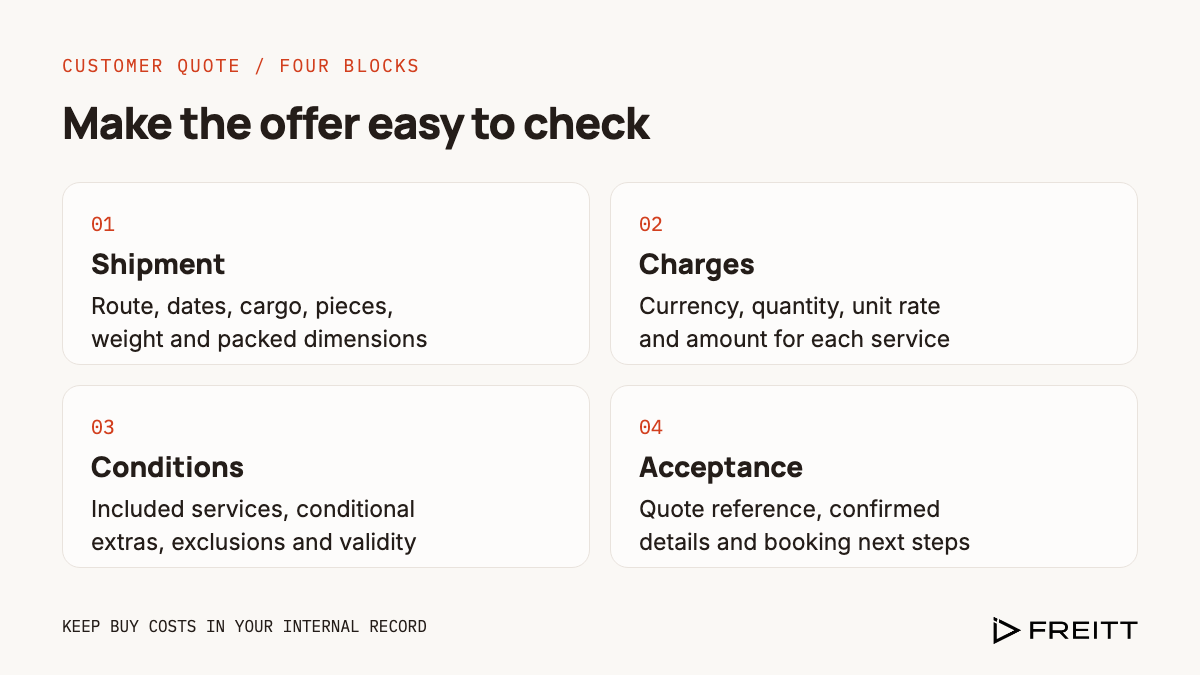
Copy this structure into your own quote format. Replace every bracketed field, delete irrelevant rows, and keep the quote number attached to later revisions.
Shipment and Service Details
Quote reference: [reference] | Version: [version] | Issued: [date]
Prepared for: [customer business and contact]
Customer RFQ reference: [reference]
Collection: [address or agreed service point]
Delivery: [address or agreed service point]
Ready date and requested delivery window: [details]
Commodity and packaging: [description, pieces and packaging type]
Gross weight and packed dimensions: [weight, dimensions and units]
Mode, equipment and service scope: [details]
Special requirements: [confirmed access, handling or cargo needs]
Price Breakdown
Charge | Quantity | Unit | Sell rate | Amount |
|---|
Main freight | [quantity] | [per shipment, kg, container or other basis] | [rate] | [amount] |
Fuel or other applicable surcharge | [quantity] | [agreed basis] | [rate] | [amount] |
Collection or origin service | [quantity] | [basis] | [rate] | [amount] |
Delivery or destination service | [quantity] | [basis] | [rate] | [amount] |
Confirmed additional service | [quantity] | [basis] | [rate] | [amount] |
Total quoted price | | [currency] | | [total] |
Conditions and Next Steps
Included: [services and service boundaries covered by the total]
Conditional extras: [trigger, allowance, charging basis and agreed rate]
Excluded: [services, duties, taxes or other costs outside the offer]
Valid until: [date, time and time zone], for [specified shipment dates]
Transit: [estimate or confirmed commitment, with its basis]
Payment: [approved payment terms]
Booking: [capacity, equipment and other confirmation requirements]
Acceptance: Reply with [quote reference], confirming [shipment details and requirements].
Do not leave “all-in” undefined. State the services included in that amount and explain how a changed shipment or newly requested service will be handled.
Freitt's rate-sheet automation workflow maps existing Excel layouts, checks validity and connects priced charges to their source rate lines. Keep the customer offer concise while retaining that supporting evidence in your internal record.
How Do You Fill Out a Freight Quote?
Fill out a freight quote by confirming the cargo and service first, pricing from valid sources second, and reviewing the customer version last. This order helps you avoid calculating a precise answer to an incomplete request.
Step 1: Confirm the Shipment Profile
Ask for packed dimensions, gross weight, piece count, commodity and handling needs. Confirm the actual collection and delivery points, including access restrictions and appointment requirements.
“Two pallets to the customer” does not tell you whether the destination has a dock. Ask about liftgate, residential or limited-access service before you select the rate and equipment.
Further reading: Use the practical LTL freight density guide when you need to check measurements before confirming classification.
Step 2: Match the Correct Rate Basis
Check whether the source prices by shipment, distance, zone, weight, volume or container. Read the minimum charge and surcharge rules alongside the main rate.
For air freight, confirm the chargeable weight and the carrier's applicable calculation rules. IATA's European Air Cargo Programme handbook describes chargeable weight as the higher of actual gross weight and volume weight.
Do not transfer an air formula into a road quote or assume an LCL rate includes destination handling. The source agreement determines what each line covers.
Step 3: Check Dates and Additional Charges
Record the rate source, version, valid dates and shipment-date conditions. Then check collection, delivery, fuel and requested extra services individually.
For fuel, follow the applicable carrier or contract method. The U.S. Energy Information Administration's fuel surcharge guidance says EIA does not calculate, assess or regulate diesel fuel surcharges. A published diesel price alone does not tell you what surcharge to charge.
Step 4: Apply Your Approved Pricing Rule
Keep your buy cost and sell price in separate fields. Record whether your rule is a markup on cost, a target gross margin, a fixed amount or a combination your team has approved.
If a quote needs an exception, record who approved it. Avoid replacing a visible rule with a number someone suggested in a chat.
Step 5: Review the Customer Copy
Check that quantities, units, totals and currency agree. Remove internal buy rates, margin notes and unresolved comments from the outgoing copy.
Read the exclusions as if you were the customer. Can you tell what happens if the cargo changes, the quote expires or the delivery needs an extra service? If the answer depends on a separate agreement, identify that agreement clearly.
Worked Example: Price a Quote Without Confusing Margin and Markup
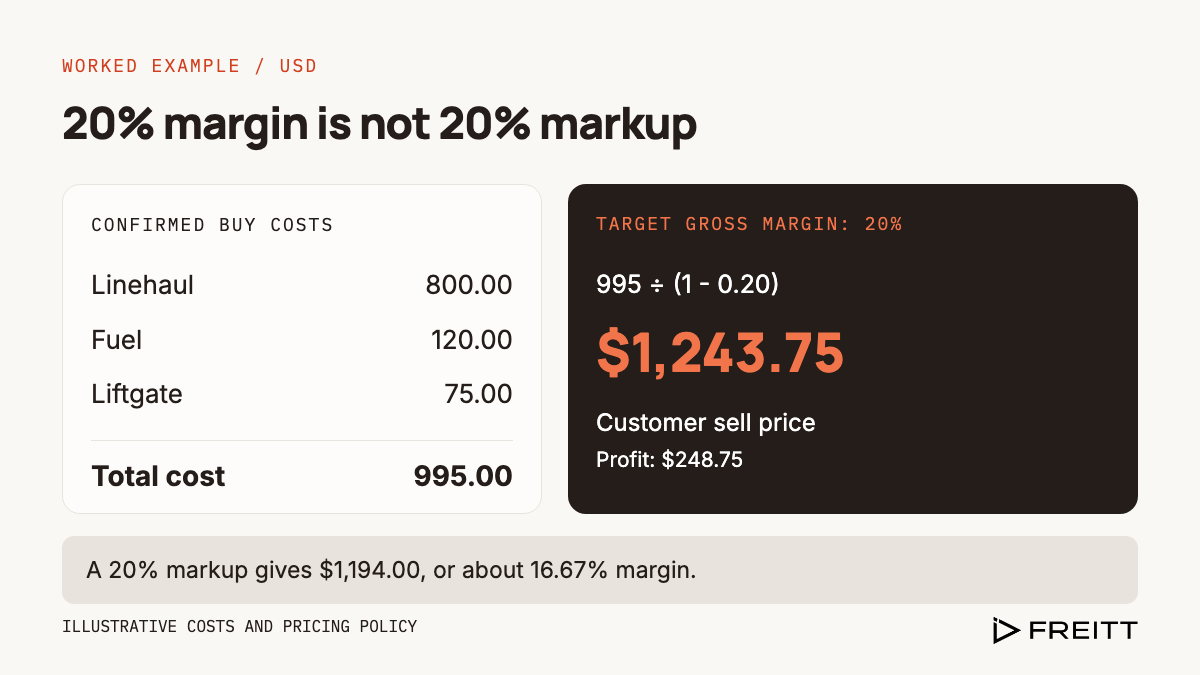
Example: You are preparing a road freight quote from carrier charges already confirmed for the shipment. Every number below is illustrative, not a live market rate, carrier tariff or recommended margin.
Internal cost line | Calculation | Buy cost, USD |
|---|
Linehaul | Agreed shipment charge | 800.00 |
Fuel surcharge | 15% of linehaul in this example agreement | 120.00 |
Liftgate delivery | Confirmed service charge | 75.00 |
Total buy cost | 800 + 120 + 75 | 995.00 |
Suppose your approved rule targets a 20% gross margin on the whole quote. Calculate sell price as cost divided by one minus the target margin:
Sell price = 995 ÷ (1 - 0.20) = USD 1,243.75
The difference is USD 248.75. Divide that by the sell price, USD 1,243.75, and the gross margin is 20%.
A 20% markup produces a different result: USD 995 × 1.20 = USD 1,194.00. The difference of USD 199 divided by USD 1,194 is approximately 16.67% gross margin. Label the rule explicitly so both reviewers calculate the same price.
If the same target margin applies to every cost line, your customer breakdown could show linehaul at USD 1,000.00, fuel at USD 150.00 and liftgate at USD 93.75. Those sell charges total USD 1,243.75 without disclosing your buy costs.
Note: This example assumes all listed costs are covered and all lines receive the same pricing treatment. Pass-through charges, taxes or customer agreements may need different rules. Recalculate the result under your actual policy.
Adapt the Template to Each Freight Mode
Keep the same quote structure across modes, then change the rating fields and service boundaries. This gives reviewers a familiar format without forcing different services into the same calculation.
Mode | Fields that need particular attention | Check before sending |
|---|
Air | Packed dimensions, gross and chargeable weight, airport pair, service scope | Weight break, minimum and separate local charges |
Ocean FCL | Container size and type, quantity, ports and inland scope | Charges per container versus per shipment |
Ocean LCL | Volume, weight, W/M basis and minimum | Origin and destination services included |
Road FTL | Equipment, lane or distance basis, dates and stops | Fuel basis, access requirements and conditional extras |
Road LTL | Commodity, packed dimensions, gross weight, NMFC item and class | Applicable classification, minimums and accessorials |
For cross-border US and Canada work, state the quote currency and who is responsible for each customs-related service. Confirm what your offer includes rather than assuming “cross-border freight” also includes brokerage or government charges.
Do not promise an appointment, sailing, flight or delivery commitment just because the price is ready. Check that operational requirement separately and describe the status accurately in the quote.
Catch Missing Charges Before They Reach the Customer
Use a short review checklist for every completed draft. Assign a named reviewer when a shipment needs a pricing or service exception.
Shipment: Do pieces, units, dimensions and weight match the RFQ?
Service: Are route, equipment, timing and access requirements confirmed?
Rates: Can each priced line be traced to a current source?
Extras: Are requested services priced, with conditional charges explained?
Commercials: Do currency, pricing rule, totals and payment terms agree?
Release: Is the customer copy complete and ready for a person to send?
A missing rate should stop that part of the quote from appearing complete. Keep the request open while you obtain the cost, or clearly separate a partial offer from the unpriced service.
In Freitt, margin and approval rules are Growth-plan capabilities. They apply configured pricing rules and route exceptions, while a person still reviews and sends the customer response.
Keep the approved version with the RFQ and source costs. When a customer changes the shipment, revise the version and explain what changed instead of quietly overwriting the accepted copy.
FAQs
What Is a Freight Quote Template?
A freight quote template is a reusable format for presenting a shipment price and the conditions behind it. It records the cargo, route, service, charges, currency and validity so you can prepare consistent offers. Keep a separate internal costing record to support the customer price and show which source rates you used.
What Information Do You Need for a Freight Quote?
You need the route, ready date, commodity, packaging, pieces, gross weight, packed dimensions and service requirements. Depending on the mode, you may also need equipment details, container type or an NMFC item and freight class. Confirm access and handling requirements before pricing, and leave unanswered questions visible until someone resolves them.
How Long Should a Freight Quote Be Valid?
A freight quote should be valid only for the period your underlying rates and offer conditions support. Check rate expiry, surcharge changes and shipment-date restrictions before setting an acceptance deadline. Write the date, time and time zone clearly, and distinguish quote acceptance from capacity confirmation. Do not copy a standard validity period without checking it.
Should Fuel and Accessorials Be Included in the Quote?
Include confirmed fuel and requested accessorials in the quoted price, and explain conditional extras separately. Show what each charge covers and its basis so the customer can compare offers fairly. If a service cost is missing, obtain it before presenting a complete offer rather than entering zero or hiding it inside a vague exclusions line.
Can You Use the Same Template for FTL and LTL?
You can share the layout, but FTL and LTL need different rating fields and checks. An FTL quote may depend on equipment, lane, dates and stops, while LTL also requires careful commodity, packaging and classification information. Keep the common customer-facing blocks, then use a mode-specific review checklist before you approve the total.
Can Software Prepare a Quote From Your Template?
Software can prepare a quote draft when it has valid shipment details, source rates, pricing rules and your format. Check how it handles missing costs and ambiguous requests before relying on the result. Freitt drafts from your own rate sheets and flags gaps; your team remains responsible for reviewing and sending the customer quote.
Put Your Quote Format to Work
Start with one completed RFQ and the rate sheet that supports it. Use the template to check scope, rebuild the price and make the conditions clear before anyone sends the offer.
Book a Demo with that RFQ and rate sheet to see how the draft is prepared for your team's review.