Two coordinators receive the same LTL request. One adds a percentage to the transport cost. The other divides by the amount needed to reach a target margin. Both believe they followed the customer's pricing rule, but they produce different quotes.
LTL customer pricing rules should define the calculation basis, applicable customer agreement, minimums and approval conditions before a draft is prepared. A percentage on its own does not tell your desk enough.
This guide shows you how to write a checkable rule record, apply it in a repeatable order and route exceptions without holding every complete request. You will also get a worked example that separates markup, percentage margin and a minimum dollar contribution.
Key Takeaways
Define the approved cost basis before applying a customer pricing rule.
Keep carrier rating minimums separate from your customer price and contribution floors.
Specify whether a percentage means markup on cost or margin on selling price.
Route conflicting rules and unauthorized concessions to a named reviewer.
Retain the calculation, rule version and approval evidence with the quote draft.
Separate Carrier Rating from Customer Pricing
Carrier rating determines the applicable transport charges under the relevant source terms. Customer pricing determines the amount you offer your customer under an approved commercial policy. Keep those decisions identifiable even when one system prepares the draft.
For a broker or reseller, the pricing basis may be an approved purchased-transport total. For an LTL carrier pricing its own service, finance may define an internal operating-cost or contribution basis. Label that basis precisely: a contribution calculated from selected costs is not automatically the company's accounting gross margin.
Do not apply a margin formula to a tariff base and assume you have established a valid transport cost. First resolve the governing agreement, rate validity, service requirements, fuel treatment and applicable extra charges.
The FedEx Freight tariff and rates resource separates rules tariffs, current rates and fuel surcharge information. That is a useful reminder to identify each relevant source instead of treating a spreadsheet's headline rate as the complete instruction.
Keep these minimums distinct:
A carrier rating minimum is part of the applicable transport pricing terms.
A customer selling-price floor is your approved minimum offer for the defined service.
A dollar contribution floor is the required difference between selling price and the defined cost basis.
Note: A commercial floor does not authorize you to change an existing customer agreement. If they conflict, hold the affected offer for a decision.
Build an Explicit Customer Rule Record
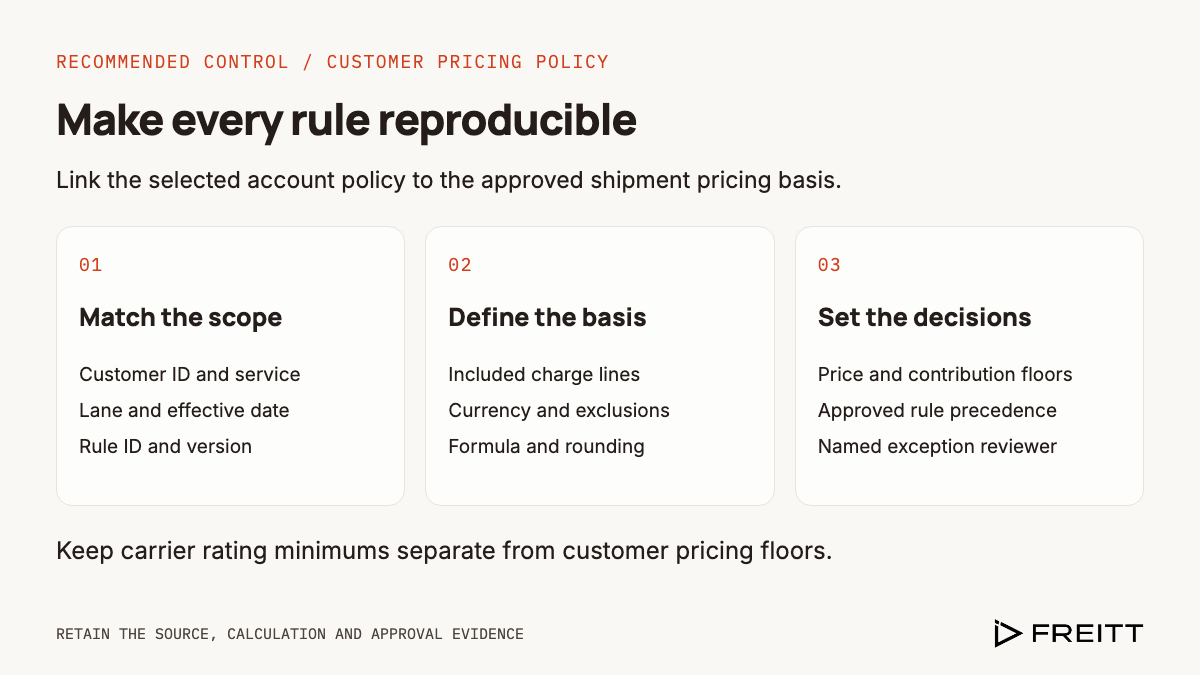
A rule record should let another coordinator reproduce the result without asking what the author intended. Use stable customer identifiers and named fields rather than relying on an account nickname in a spreadsheet tab.
Start with this operating template. The fields describe a recommended desk control, not a claim that every field is a native software setting.
Rule field | What you record | Why it matters |
|---|
Identity and scope | Rule ID, customer ID, mode, service and lane scope | Prevents another account's policy being selected |
Validity | Effective date, expiry and applicable date basis | Makes the chosen version explainable |
Calculation basis | Included cost lines, currency and source references | Defines what receives the percentage |
Pricing method | Markup, target margin, fixed addition or agreed sell rate | Removes ambiguity about the formula |
Floors and exclusions | Dollar contribution, selling-price floor and pass-through lines | Defines what can and cannot change |
Decision ownership | Approver, override reason and review conditions | Makes exceptions actionable |
Write down whether fuel and accessorials receive the same treatment as linehaul. If a service charge passes through unchanged, say so and define whether it belongs in the reported margin denominator.
Keep currencies explicit. A USD contribution floor cannot be compared directly with a CAD quote. Use an approved conversion policy where one exists, or route the currency mismatch for review.
Use source traceability alongside the rule record. Freitt's rate-sheet automation workflow maps existing sheets, rates, charges and validity so a quote can show where its numbers came from. Confirm the source before adding the customer policy.
Apply Rules in a Defined Order
Step 1: Establish the Eligible Source and Customer
Confirm the customer account, shipment facts, service, source validity and included charges. Missing dimensions, uncertain weight or unresolved accessorial requirements belong in clarification before you treat a cost total as complete.
Further reading: Use the LTL quote data validation guide to separate populated fields from confirmed rating inputs. A pricing formula cannot repair an uncertain shipment record.
Step 2: Select One Authorized Pricing Policy
Document how general account rules interact with narrower lane or service rules. A narrower match should take priority only when your approved policy says it does. Do not assume that the newest file or most specific-looking row automatically overrides an agreement.
Record the selected rule ID and version. If two active records both match and no approved precedence resolves them, route that request for review. Leave unrelated requests moving.
Step 3: Calculate, Check Floors and Record the Result
Apply the selected formula to its stated basis, then evaluate the defined floors and exclusions in the approved order. Record how you round, at what stage you round and which currency precision applies.
Keep carrier rating instructions independent of this internal sequence. Old Dominion's tariff resource specifies that its Rules 100 tariff applies in connection with tariffs making the required reference. Check applicability rather than copying a rule from an unrelated rate program.
Tip: Test the calculation with an independent calculator or reviewed worksheet. Matching a formula in two copied spreadsheet cells is not an independent check.
Worked Example: Check Margin and a Dollar Floor
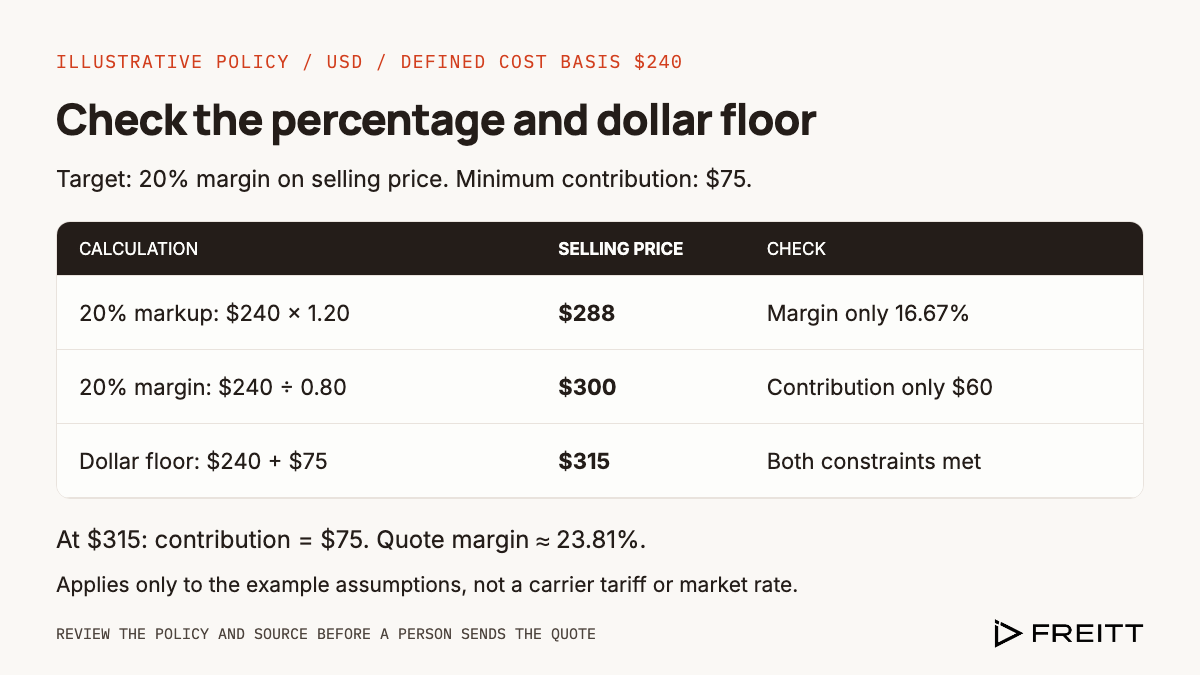
Example: A fictional LTL pricing policy uses an approved USD cost basis of $240. Its included charges are already resolved. The policy requires a 20% quote margin on selling price and at least $75 contribution above that cost basis.
Assume all included charges receive the same treatment, no separate pass-through lines or taxes apply, and no fixed customer sell rate conflicts. These are example policy choices, not carrier tariff instructions or recommended market prices.
For this example, define:
Contribution dollars = selling price minus the defined cost basis.
Quote margin percentage = contribution dollars divided by selling price.
Markup percentage = contribution dollars divided by the cost basis.
A 20% markup would produce $240 × 1.20 = $288. The $48 contribution divided by $288 is approximately 16.67%, so it would not satisfy the stated 20% margin target.
To reach a 20% margin, divide the cost basis by one minus the target: $240 ÷ 0.80 = $300. That creates $60 contribution, which satisfies the percentage requirement but misses the $75 dollar floor.
The dollar-floor candidate is $240 + $75 = $315. Under this fictional policy, both constraints apply, so the proposed selling price is the higher candidate: $315.
Check the result:
Contribution: $315 minus $240 = $75.
Quote margin: $75 ÷ $315 ≈ 23.81%.
Both the 20% target and $75 contribution floor are met.
Now suppose a new confirmed service requirement increases the approved cost basis to $264. Keeping the old $315 offer would leave only $51 contribution, below the floor. Recalculate against the changed input and review any offer already prepared or sent.
Note: These percentages describe the defined quote basis. They do not establish total business profitability, an industry benchmark or a measured customer outcome.
Route Conflicts Instead of Silently Changing Prices
An exception should identify the decision required, not merely say that the quote failed. Give the reviewer the eligible source, selected policy, proposed amount and conflicting condition.
Use specific approval triggers such as:
A customer agreement fixes a price below the current internal floor.
A requested concession falls outside the coordinator's authority.
Two active policies match without an approved priority.
A charge is missing, expired or in a different currency.
A changed shipment input invalidates an earlier calculation.
For a fixed-price conflict, do not raise the offer automatically and describe it as compliant. Ask the authorized owner to confirm the applicable agreement or approve a documented exception within their authority.
Keep the original candidate and the requested concession visible. Record the approver's decision, reason, scope and expiry. Approval for one shipment should not become a standing account policy unless someone explicitly authorizes that change.
Freitt's margins and approvals workflow supports configured customer, lane and mode rules, with exceptions routed to named approvers. A person still reviews and sends the customer quote. The template and calculation choices in this guide need to be checked against your actual setup.
Test Changes Before Releasing More Drafts
Before enabling a revised policy, prepare an expected-results worksheet approved by the policy owner. Include ordinary requests and boundary cases that expose conflicting instructions.
Your test set should cover a low-cost shipment where the dollar floor governs, a larger shipment where the percentage governs, a fixed customer price, an expired policy and overlapping account rules. Add pass-through charges, currency mismatches and changed shipment inputs where your desk handles them.
For each case, retain:
Source and policy versions used.
Expected candidate and final permitted amount.
Actual result and any rounding difference.
Required reviewer and observed routing.
Separate preparing a draft from authorizing its release. If a policy changes while requests are open, identify which drafts need recalculation and which sent offers need commercial review. Keep the earlier version for traceability.
Tip: Review recurring overrides with the policy owner. Repeated exceptions may reveal an outdated agreement or unclear scope, rather than a need to weaken every floor.
FAQs
What are LTL customer pricing rules?
LTL customer pricing rules define how an approved shipment pricing basis becomes a customer offer. They can specify account eligibility, calculation method, included charges, floors and approval conditions. Keep them linked to the applicable agreement and source version so your team can explain why a particular rule was selected.
What is the difference between margin and markup?
Margin uses selling price as the denominator, while markup uses cost. With a $240 cost basis and $300 selling price, the $60 difference equals a 20% margin and a 25% markup. Label the method explicitly in your rule record because the same percentage produces different selling prices.
Is a carrier minimum the same as a minimum margin?
A carrier minimum and a minimum margin control different things. The carrier minimum belongs to the applicable transport rating terms, while your minimum margin or contribution rule controls the customer offer against a defined basis. Keep both visible and resolve agreement conflicts instead of substituting one for the other.
Should fuel and accessorials receive the same markup?
Fuel and accessorials should follow the approved customer policy, which may treat them differently from linehaul. State which lines receive a percentage, which pass through unchanged and how excluded amounts affect the reported margin. Do not assume a single rule covers every charge simply because the quote shows one total.
What should happen when two pricing rules match?
Two matching rules should be resolved by an approved precedence policy or a named reviewer. Hold the affected draft when no authorized priority exists, and record the conflicting versions. Do not choose the cheaper result, newest file or narrowest lane automatically unless the documented policy explicitly permits that selection.
Can an automated LTL quote be sent without review?
Freitt prepares quote drafts for a person to review and send. A calculated price passing your rule checks does not mean a customer message has been authorized or delivered. Keep the policy version, source evidence and any approval decision with the draft, then confirm the actual sending action separately.
Make the Next Quote Easy to Check
Start with one account policy and a defined cost basis. Document the formula, floors, precedence and exception owner, then check expected results before extending the process to more requests.
To discuss preparing consistent, human-reviewed LTL quote drafts from your approved sources with Freitt, Book a Demo.