A customer needs a trucking quote, but the request arrives while you are answering a driver, checking a delivery and looking for the latest lane sheet. Preparing the offer means reading attachments, finding the right rate, checking extra charges and writing a reply before you can make the commercial decision.
The value of Freitt for small US trucking companies is in that preparation work. It reads forwarded freight requests, organizes the shipment information, uses your approved pricing sources and prepares a quote draft for your team to review and send.
Here is how that workflow can help a small trucking quote desk, including a fictional US lane example and what to check when trying it with your own requests.
Key Takeaways
Freitt prepares quote drafts from forwarded requests and supported attachments, reducing repeated reading and retyping.
Your approved road rates and configured pricing rules provide the basis for the offer.
Missing details, uncertain choices and unavailable rates need attention instead of an invented answer.
Source references and separate charge lines help your team check the proposed price.
Your people keep the customer relationship, final review and sending decision.
Where Freitt Fits in a Small Trucking Company
Freitt fits the part of your business that prepares customer freight offers from approved rates. For a small US trucking team, that might mean an owner and coordinator sharing quote work alongside other responsibilities.
You may already have a workable commercial process: customer emails, an Excel lane sheet, agreed fuel treatment and someone authorized to approve exceptions. The repeated preparation between those pieces is where Freitt can help.
Its road freight quoting workflow uses the pricing basis in the approved sheet, such as a named lane, zone or distance-based rule, together with equipment requirements and listed charges. It then prepares a traceable draft for review.
That makes the product useful to evaluate when your problem is quote preparation. Dispatching a driver, deciding whether a truck is available and accepting the load remain separate operating decisions that your team must handle.
Work at your desk | What Freitt prepares | What your team decides |
|---|
Read the customer request | Structured shipment facts from the email and supported attachments | Whether the facts and service scope are correct |
Find approved pricing | Applicable source rates, listed charges and calculation evidence | Whether the source covers this job |
Prepare the offer | A customer quote draft using the configured format and rules | Whether to approve and send it |
Follow the opportunity | Quote status and outcome information | The next commercial action |
Tip: Bring a real request and its matching approved sheet to a product session. That tests fit more clearly than a generic discussion about AI.
Freitt Reads the Request Before You Start Rebuilding It
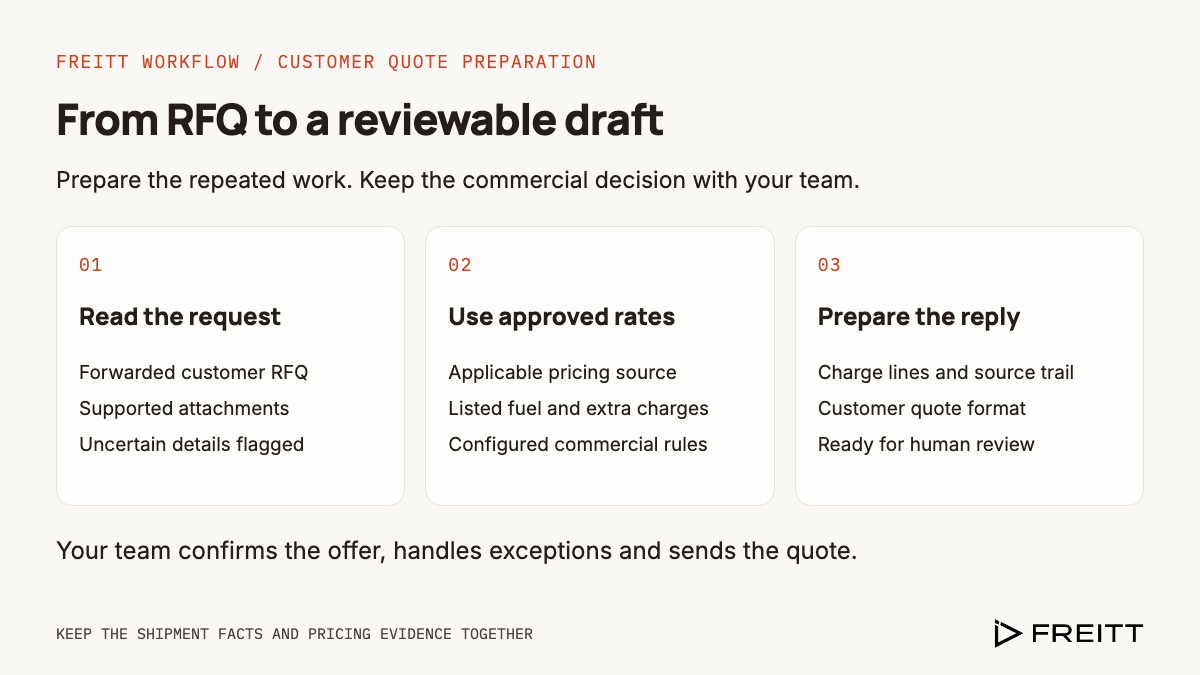
With email-to-quote preparation, you forward the RFQ to Freitt. It reads the message and supported PDF, Excel, Word or image attachments, then structures the information needed for the quote.
This addresses a familiar small-company problem: the lane is in the email, the cargo details are in a packing list and the requested date is buried farther down the thread. Your coordinator should not have to recreate the same shipment from scratch in each place.
Freitt flags uncertainty for a person and prepares clarification drafts when information is missing. If a weight could mean either one pallet or the whole shipment, your team can resolve that question before treating it as a reliable pricing input.
For context, the FedEx Freight shipment guide identifies information such as shipment locations, classification, total weight, ready date and special handling. Your own requirements depend on the service and agreement, but incomplete inputs still need a clear answer.
The practical benefit is less switching between reading, copying and composing a question. Your attention can go to confirming the facts and deciding what the customer needs next.
Note: The working intake method is forwarding from an inbox that supports it. Native Gmail and Outlook connections are described as coming soon, so evaluate the available workflow rather than assuming a direct mailbox integration.
Freitt Connects the Request to Your Approved Rates
Step 1: Map the Rate Sheet Your Team Uses
Freitt's rate-sheet automation maps your existing Excel layout rather than requiring you to recreate it in a standard template. Rates, charges and validity become part of the source information used to prepare drafts.
For a trucking company, the useful question is whether the sheet expresses your actual offer: the right lane or zone, equipment, service scope, minimum and additional charges. Mapping the document does not remove the need for an approved commercial source.
Step 2: Prepare the Price on the Applicable Basis
Once the request and source match, Freitt uses the sheet's road-pricing basis and the configured commercial rules. Fuel and accessorials come from the listed source terms, with charge lines that a reviewer can follow.
Your LTL and FTL requests may require different source instructions. A dedicated-truck lane offer should not inherit an unrelated LTL rule simply because the destinations look similar.
Carrier terms also have an applicability scope. Old Dominion's tariff resource, for example, explains that its Rules 100 tariff applies in connection with tariffs making the relevant reference. Your team should confirm which approved terms govern the request before using the draft.
Step 3: Surface the Gap When Pricing Is Unavailable
If no valid rate covers the request, Freitt flags the missing source and can prepare a carrier inquiry draft. Expired rates and uncertain source choices need resolution rather than a guessed price.
This matters when several people share quoting. A colleague reviewing the work can see that a source is missing instead of mistaking an unsupported number for an approved offer.
Tip: Try an uncovered lane as well as an ordinary request. Seeing how the product presents uncertainty is part of evaluating its usefulness.
Example: A US Trucking Request Becomes a Checkable Draft
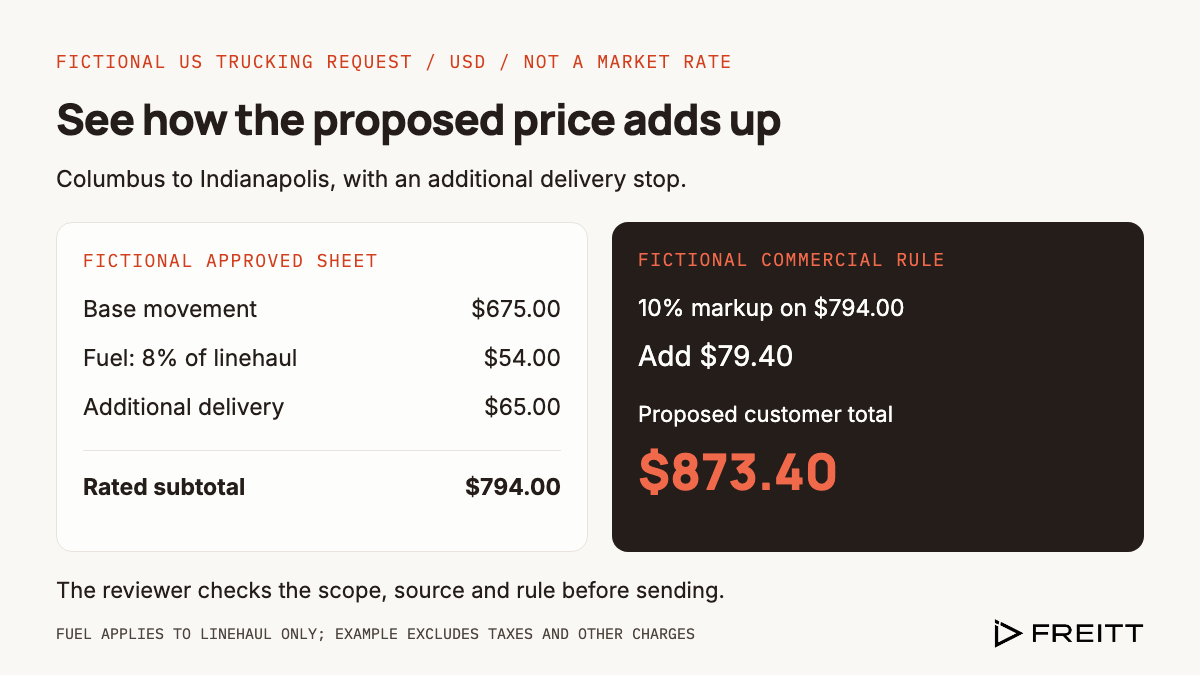
Example: A fictional customer asks a small trucking company for a dedicated dry-van move from Columbus, Ohio, to Indianapolis, Indiana, with a second delivery stop in the same destination area. The cargo, dates, addresses and equipment requirements have been confirmed.
The company's fictional approved sheet covers that exact service scope. It lists USD $675 for the base movement, fuel at 8% of linehaul only and $65 for the additional delivery stop. A configured commercial rule adds a 10% markup to the rated subtotal.
Those figures are invented solely to explain the workflow. They are not current lane rates, a customer result or a carrier tariff example.
The independently checked calculation is:
Base movement: $675.00.
Fuel: $675.00 × 8% = $54.00.
Additional delivery stop: $65.00.
Rated subtotal: $675.00 + $54.00 + $65.00 = $794.00.
Approved markup: $794.00 × 10% = $79.40.
Proposed customer total: $873.40.
In a Freitt walkthrough, ask to see the information carried from the request, the applicable source and the rule behind that draft. Your reviewer should be able to trace the extra stop charge and confirm that fuel used only the stated linehaul basis.
The person reviewing still checks the shipment scope, equipment suitability, source validity, customer terms and any required approval. The draft does not establish that a vehicle is available or that the job has been accepted.
If the customer removes the extra stop, the earlier total needs review against the changed request. Do not simply reuse the offer because the main city pair stayed the same.
Note: A 10% markup in this example is not a 10% margin on selling price. The calculation follows the stated fictional rule, with no taxes or other charges included.
A Busy Desk Gets Help with Preparation and Visibility
When several RFQs arrive together, each one can create another cycle of reading, copying, rate lookup and reply formatting. Freitt prepares those repeated parts so your staff can concentrate on the request-specific judgment.
That is the mechanism behind the productivity benefit. It does not establish a guaranteed response time or a tested number of quotes per hour for your business.
A useful way to evaluate the change is to follow ordinary requests and exceptions separately:
For complete requests, check whether the draft carries the right facts, rates and charges into a usable reply.
For incomplete requests, check whether the open question is clear enough for your team to resolve.
For missing rates, check whether the gap is visible before anyone offers a price.
For approval cases, check whether the required decision stays with the authorized person.
Freitt also provides quote tracking and analytics, including request status, time to draft and send, customer response and recorded outcomes. This gives your team a way to review what happened after preparation rather than measuring only how many drafts appeared.
For a small company, that visibility can support a practical handover conversation: which requests are ready, which are waiting and which offers need follow-up. Your team can use the recorded context to decide the next action.
Follow-up messages remain drafts for a person to review and send. An active quote record is not permission for an automated customer message.
Try Freitt on the Work Your Company Actually Quotes
Start with requests your team understands well. Use owned customer emails and approved source sheets, including one complete request, one missing-detail case and one rate exception.
Ask the product session to follow the same facts through intake, source selection, calculation, reply preparation and review. If your business handles both LTL and FTL, include each, with its own approved pricing instructions.
Judge the result against practical questions:
Did the shipment details carry through correctly?
Could you identify the source and explain every charge?
Did missing information or unavailable rates stay visible?
Was the draft suitable for your customer format and terms?
Did the right person keep the final decision?
Freitt works alongside existing email, spreadsheets and TMS processes. Bring your current handoffs to the session so you can distinguish work it prepares from work that remains in your other systems.
The goal is a useful draft your team can check and act on, with fewer repeated preparation steps between the customer request and that decision.
FAQs
Can Freitt help a small US trucking company prepare quotes?
Freitt can help with quote preparation when your team prices customer requests from approved road-freight sources. It reads forwarded RFQs, uses supported shipment and rate information and prepares a reply for review. Test your own LTL or FTL requests to confirm the fit for your company's pricing instructions and service scope.
Does Freitt calculate live market rates for every trucking lane?
Freitt prepares quotes from your approved sources rather than inventing a market rate for an uncovered lane. If no valid rate is available, it flags the gap and can draft a carrier inquiry. Confirm the specific source coverage for your business instead of assuming universal live carrier or spot-market connectivity.
Can we keep using our existing Excel rate sheets?
Freitt maps existing Excel rate-sheet layouts during setup so your team can work from its approved sources. Bring a sheet that includes the service basis, charges and validity needed for your requests. Check the resulting mapping and calculation with familiar examples before relying on drafts for additional lanes or services.
Will Freitt send quotes to customers automatically?
Freitt does not send customer quotes on its own. Your team reviews the prepared draft, checks any required approval and sends the offer. The same human review and sending requirement applies to clarification and follow-up drafts, so preparing a message does not mean that the customer has received it.
Does Freitt replace our dispatch software or TMS?
Freitt works alongside existing email, spreadsheets and TMS processes. Its role here is preparing freight quote drafts, not deciding vehicle availability or dispatching a driver. Review your handoffs during a demo and verify any specific integration separately rather than assuming that working alongside a system means a native connection exists.
How can we tell whether Freitt helps our quote desk?
Evaluate Freitt on your own complete requests and exceptions, then compare preparation effort, required corrections and review quality with your current process. Keep the service and source scope comparable. Recorded time-to-draft, time-to-send and outcome information can support the assessment, but your actual results should determine the business case.
See Freitt Prepare One of Your Trucking Quotes
Bring a real US trucking RFQ, the approved sheet that covers it and a request that usually needs extra attention. You can see how Freitt prepares the work and check what your team still needs to decide.
Book a Demo to walk through your request, your rates and your quote format.