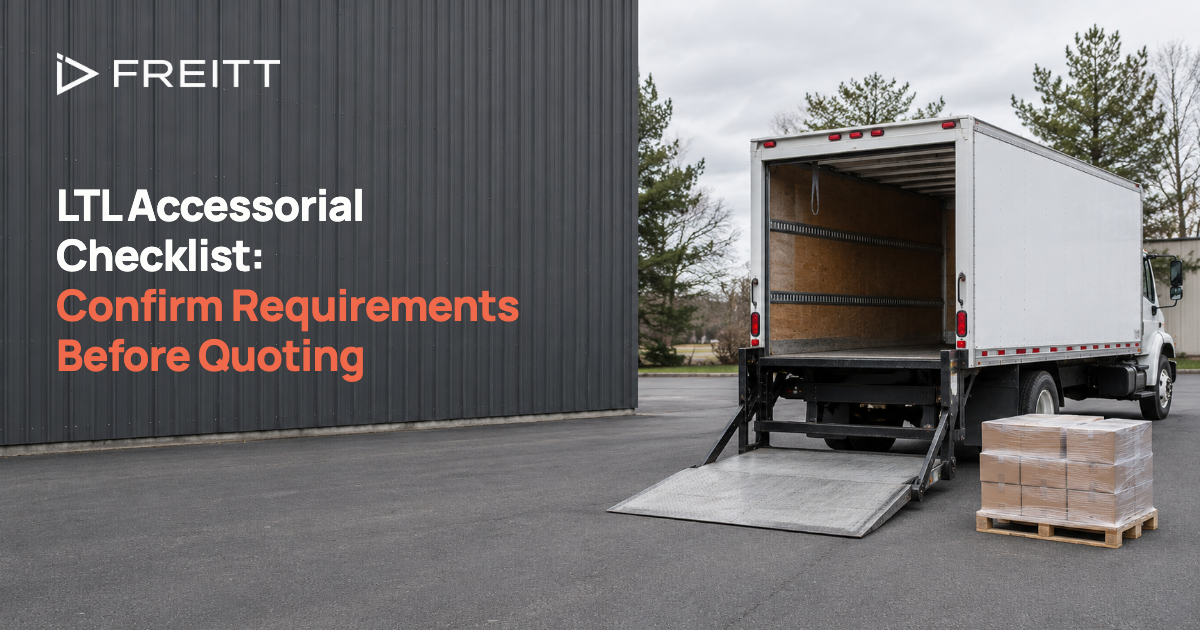
“Commercial delivery” does not tell you whether a freight truck can reach the entrance, unload the pallet or arrive during receiving hours. If you quote from the address alone, the missing detail may surface when the driver reaches the site.
An LTL accessorial checklist records the services and site conditions that can change a less-than-truckload quote. Complete it separately for pickup and delivery, then match each confirmed requirement to the selected carrier's terms.
This guide gives you a practical checklist, a step-by-step review process and a worked pricing example. You'll learn how to distinguish liftgate, residential, limited-access, appointment and inside-delivery requirements without treating them as interchangeable.
Key Takeaways
Check pickup and delivery separately because the equipment and access conditions can differ.
Confirm the carrier's definitions before choosing residential or limited-access service.
Treat liftgate, inside handling and delivery appointments as distinct requirements.
Price confirmed services from the applicable agreement and keep unresolved requirements visible.
Carry the agreed instructions into the booking handover and bill of lading.
What Are LTL Accessorials?
LTL accessorials are services or conditions priced in addition to the shipment's base transportation scope. The applicable carrier agreement determines when a charge applies, what it covers and whether another service is already included.
A charge may relate to equipment, location, timing or additional handling. Some requirements can be identified before quoting. Others, such as waiting beyond an allowance or a failed delivery attempt, depend on what happens during the move.
Avoid turning a generic list into a universal fee schedule. Carrier rules, account agreements and service availability matter more than a remembered price from another shipment.
Use these working categories:
Equipment: liftgate, suitable vehicle size or special handling arrangements.
Location: residential, secured, restricted or otherwise carrier-defined limited access.
Timing: appointments, advance contact or service outside the accepted receiving window.
Handling: movement beyond the standard handoff point or an agreed unloading service.
Events: detention, redelivery or storage under the applicable terms.
Note: A requested service still needs carrier acceptance. Selecting a checkbox does not prove the equipment is available or the delivery is feasible.
The LTL Accessorial Checklist for Pickup and Delivery
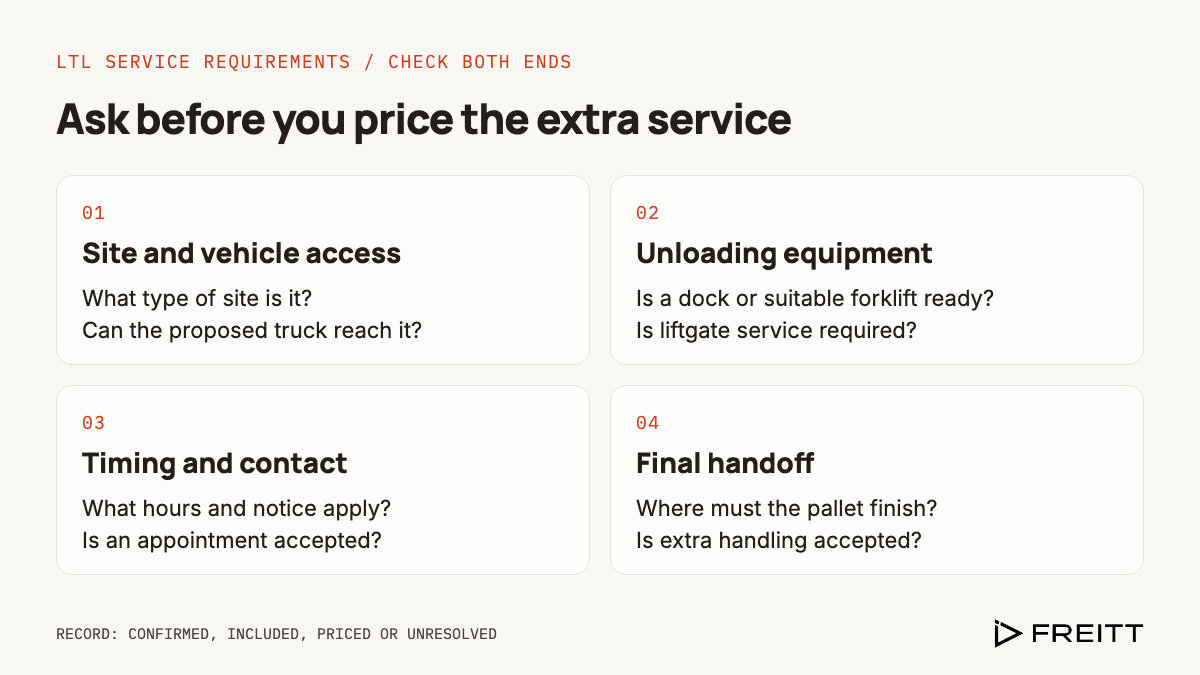
Complete the same questions for both ends of the shipment. Record the answer, who confirmed it and whether the requirement is priced, included or unresolved.
Check | Ask the shipper or receiver | Record for the carrier |
|---|
Site type | What kind of location is this, including any home-based business or secured site? | Actual site description and carrier-confirmed service category |
Vehicle access | Can the proposed vehicle enter, turn and reach the unloading point? | Gate, road, height and turning restrictions |
Dock and unloading | Is a usable dock or suitable forklift available when the truck arrives? | Equipment, responsible person and any liftgate requirement |
Receiving schedule | What hours, closures and appointment rules apply? | Time zone, contact and accepted scheduling instructions |
Final handoff | Where must the freight be left, and what movement is required after unloading? | Agreed handoff point and any inside-handling scope |
Freight readiness | What are the packed dimensions, weight, handling units and stackability? | Shipment measurements and handling restrictions |
Special requirements | Does the cargo need declared hazardous-material handling or another special service? | Accurate description and carrier acceptance requirements |
Exceptions | What happens if unloading, access or attendance is unavailable? | Allowances, event-based charges and escalation contact |
A postal code and business name do not answer all those questions. Ask the person who actually receives freight, rather than relying only on the customer who placed the order.
Tip: Use “yes,” “no” and “not confirmed” as separate answers. An empty cell should never mean that a service is unnecessary or free.
Which Services Need Separate Confirmation?
Confirm the equipment, location, timing and handoff requirements individually. One condition may create several service needs, while an agreement may include one charge within another.
Liftgate Versus Inside Delivery
A liftgate helps transfer freight between vehicle height and ground level. It does not, by itself, define how far the driver will move the pallet afterward.
Ask whether the site has a usable dock or unloading equipment, and whether it will be available at the planned time. Confirm the packed unit's dimensions and weight against the carrier's equipment limits. A pallet jack at the receiver does not explain how the pallet will get down from trailer height.
For inside handling, describe the requested destination, route, surface, door clearance and any steps or stairs. Do not assume standard inside service includes unpacking, room placement, assembly or debris removal. Obtain an accepted service description before quoting those tasks.
Residential Versus Limited Access
Describe the actual site before assigning a category. A business operated from a home, a school, a storage facility and a gated industrial site may require different treatment under the selected carrier's rules.
The FedEx Freight rules tariff lists residential, limited-access and liftgate services under separate items. Use the applicable section and agreement to check definitions, charges and exceptions. Do not copy a U.S. charge into Canadian or cross-border work without confirming it applies.
Appointment Versus Call Before Delivery
A call before delivery provides notice. An appointment involves an accepted scheduling arrangement. Neither phrase alone establishes a guaranteed transit commitment.
Write down whether the receiver needs an agreed date, a time window or simply advance contact. Check whether the carrier accepts the requested window and whether notification is already included in another applicable service.
Tip: Ask “What must happen before this receiver will accept the freight?” That usually produces a more useful answer than “Do you need an appointment?”
How Do You Turn Site Answers into a Checkable Quote?
Turn each confirmed requirement into a defined service line or an explicit inclusion. Stop and clarify anything that could change the carrier's ability to complete the shipment.
Step 1: Confirm Each End with a Named Contact
Record who supplied the information and when. A pickup warehouse may have a dock while the delivery site needs ground-level unloading, so avoid copying one endpoint's answers to the other.
Ask about the actual arrival conditions, including lunch closures, gate procedures and available unloading staff. If a customer says “there should be a forklift,” treat availability as unresolved until someone confirms it.
Step 2: Check the Chosen Carrier and Agreement
Match the answers to the carrier's applicable service definitions, account terms and effective dates. Review minimums, units, included services and any restrictions on combining charges.
Save the source beside your costing. A public tariff is a reference, but your accepted quote or agreement may contain different terms. Request clarification when the source is missing, ambiguous or out of date.
Step 3: Resolve Feasibility Before Finalizing Price
Describe any unloading or site constraint the standard service may not cover. A narrow entrance, unsuitable surface or handling unit beyond equipment limits is an operational question, not just another amount to add.
Freitt's email-to-quote workflow reads RFQs and attachments and raises missing or ambiguous shipment details. Use the resulting clarification draft to obtain an answer, then have your team review the revised scope.
Step 4: Show Inclusions and Conditions Clearly
Separate confirmed charges from event-based conditions. State which endpoint needs the service and keep your original source available for review.
For the overall customer-facing structure, use the existing freight quote template guide. The accessorial checklist supplies the service detail that belongs inside that offer; it does not replace the quote's validity or acceptance conditions.
Worked Example: A School Delivery with No Dock
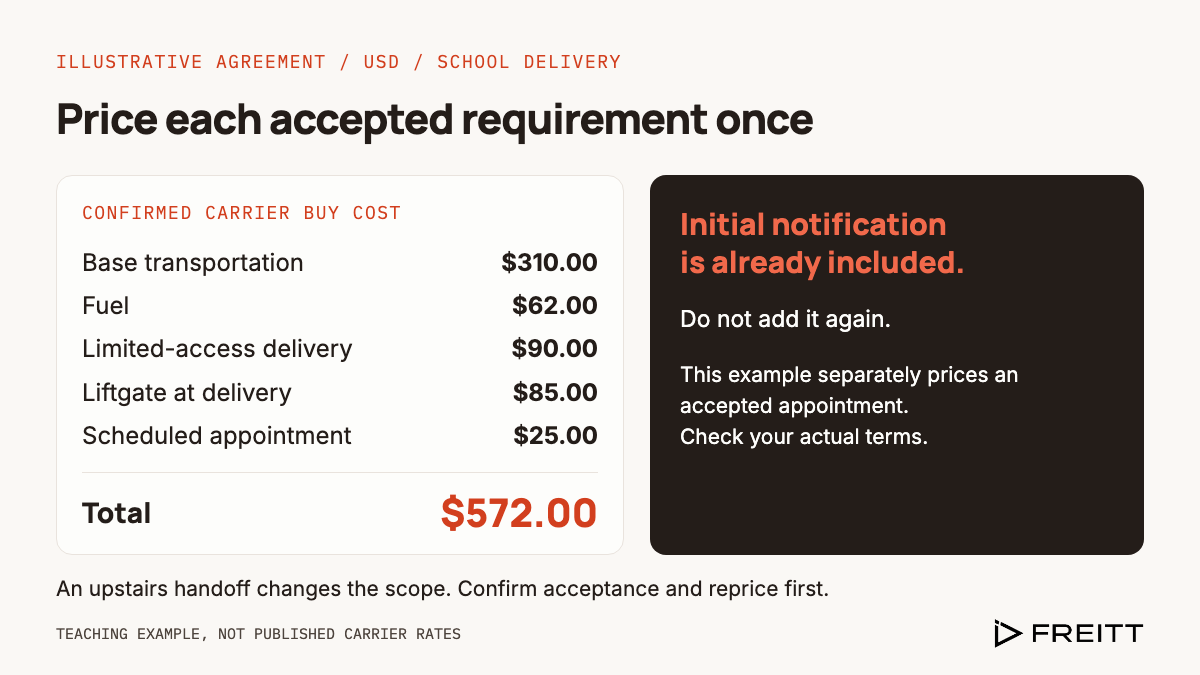
Example: Your customer requests delivery of one packed pallet to a school. The receiver confirms no dock or forklift, a ground-level handoff on suitable pavement and an appointment requirement. The carrier accepts the freight and site conditions.
For this teaching example, the hypothetical agreement treats the school as limited access, prices liftgate delivery separately and permits a separate scheduled-appointment charge. Initial notification is already included in limited-access service. These are illustrative USD amounts, not published carrier rates.
Confirmed component | Illustrative amount | Scope note |
|---|
Base transportation | $310.00 | Accepted shipment and lane |
Fuel | $62.00 | Confirmed amount under the example offer |
Limited-access delivery | $90.00 | Includes initial notification in this example |
Liftgate at delivery | $85.00 | Accepted ground-level unloading arrangement |
Scheduled appointment | $25.00 | Separate accepted service under this agreement |
Total carrier buy cost | $572.00 | Before your customer pricing rules |
The calculation is $310 + $62 + $90 + $85 + $25 = $572. Do not add a second initial-notification charge when that service is already included.
Now suppose the receiver also asks for the pallet to be taken upstairs. That changes the handoff scope. Hold the customer draft while you confirm an accepted handling solution and revised price; do not assume the liftgate or inside-service label covers it.
Freitt's road-freight quoting workflow applies equipment and rate-basis information with sheet-defined fuel and accessorials. Your desk must supply approved terms, resolve missing requirements and review the draft before sending it.
Note: Keep possible detention, redelivery and storage conditions visible. They are not guaranteed events to add to this example's confirmed total.
What Should Match Before You Hand the Shipment Over?
The accepted quote, carrier instructions and shipping paperwork should describe the same required services. Reconcile them after any change to the site, cargo or receiving arrangement.
The NMFTA guide to bill-of-lading information identifies special handling and accessorial details as information to include when necessary. Use clear instructions and the carrier's required fields rather than relying on a note buried in an old email.
Before handover, check:
Pickup and delivery addresses match the accepted scope.
Liftgate and other services are assigned to the correct endpoint.
The receiving contact, phone, hours and time zone are current.
The accepted appointment process is recorded without implying an unconfirmed guarantee.
Packed dimensions, weight and handling instructions agree across the records.
The agreed final handoff point is explicit.
Revised requirements have been accepted and repriced where necessary.
Unresolved items have an owner and are not concealed inside a completed status.
Keep the source confirmation with the handover record. If the receiver changes the instructions, review the quote and carrier acceptance again before treating the change as covered.
FAQs
What should an LTL accessorial checklist include?
Include site type, vehicle access, unloading equipment, receiving hours, contacts, appointment needs and the final handoff point at both pickup and delivery. Add packed freight measurements and any special handling requirements. Record whether each requirement is confirmed, priced, included or unresolved, with a source and owner for any outstanding question.
Do you need a liftgate if the receiver has a pallet jack?
A pallet jack alone does not establish a way to lower freight from trailer height to the ground. Confirm whether the receiver has a usable dock or suitable unloading equipment and whether it will be available. If liftgate service is needed, check the carrier's equipment limits and obtain acceptance for the packed handling unit.
Is liftgate delivery the same as inside delivery?
Liftgate delivery and inside delivery describe different parts of the handoff. The liftgate addresses movement between vehicle height and ground level, while inside handling concerns an additional agreed movement. Ask where the freight must finish and confirm the carrier's scope. Do not assume stairs, unpacking or room placement are included in either label.
What counts as a limited-access LTL delivery?
A limited-access delivery is one that meets the selected carrier's definition for that service. Examples may include schools, secured sites or other restricted locations, but definitions and exceptions vary. Describe the actual premises and access conditions to the carrier. Confirm the applicable agreement instead of assuming a business name or postal code settles the category.
Is a delivery appointment the same as a call before delivery?
A delivery appointment and a call before delivery are different requirements, although a carrier may group or include them under particular terms. An appointment concerns an accepted scheduling arrangement; a call provides notice. State what the receiver actually requires, confirm carrier acceptance and check whether notification is already included in another priced service.
Can an LTL invoice exceed a quote that includes accessorials?
An invoice can exceed the quoted amount when shipment details, required services or actual events differ from the accepted scope under the applicable terms. Including known accessorials does not remove every conditional charge. Retain the confirmed requirements and compare any later billed item with the accepted offer, service evidence and carrier agreement.
Review the Delivery Requirements Before You Send the Quote
A useful checklist turns “standard delivery” into specific, confirmed instructions. Check both endpoints, verify the applicable terms and leave unresolved requirements visible until someone answers them.
Bring one LTL request and its approved rate sheet to see how Freitt prepares a quote draft for human review. Book a Demo.