A truckload request arrives with a pickup date but no trailer specification. Another customer needs two pallets delivered to a business without a loading dock. Both need prices quickly. Both contain details that can change the bill.
AI-powered quote desks help by turning scattered shipment information into structured inputs, matching those inputs to valid rates, calculating charges, and preparing a reviewable quote. Appropriate pricing means covering the actual service, applying commercial rules consistently, and showing where the numbers came from.
For U.S. trucking operations, full truckload (FTL) and less-than-truckload (LTL) require different rating logic. Here is how a dependable workflow handles each, and where Freitt can help.
Key takeaways
FTL pricing depends on the lane, equipment, timing, capacity, and agreed service.
LTL pricing needs accurate weight, dimensions, classification, and carrier-specific rules.
AI extraction, market prediction, and rate calculation serve different purposes.
Fuel, accessorials, minimums, and margin rules must remain visible.
Freitt prepares traceable road-freight quotes from your approved rate sheets, with human review.
What an AI quote desk actually does
The workflow has three layers. First, AI reads an RFQ, or request for quotation, and extracts shipment details from emails and attachments. Second, a rating engine applies approved prices and explicit calculation rules. Third, a person reviews exceptions and authorizes the customer quote.
Some systems also predict truckload buy rates using historical transactions and market information. Triumph Intelligence documents predicted buy rates and confidence levels. Those predictions support negotiation; they are different from an agreed carrier price. Software should identify which kind of number it is presenting.
How AI-powered quote desks price FTL loads
Start with the complete operating requirements
FTL generally reserves a truck for one shipment, even when the trailer is not physically full. Capture origin and destination ZIP codes, pickup and delivery windows, equipment, commodity, weight, stops, and handling requirements. Refrigeration, appointments, or tight delivery windows can change the carrier options and cost.
The desk should ask about missing requirements before pricing. A dry-van assumption cannot safely substitute for a refrigerated trailer, and a delivery deadline should not disappear when an email becomes a quote.
Match the lane to relevant rates
For contracted freight, use the applicable carrier agreement and its effective dates. For spot freight, compare recent bookings and current carrier offers with relevant market benchmarks. DAT explains that its transaction-based rates are negotiation references; geography, timeframe, equipment, and fuel inclusion matter when comparing figures.
An AI-assisted desk can surface differences between the request and comparable loads. The operating rule should be clear: stale or weak evidence triggers review. A market average cannot confirm that a suitable truck is available for this particular pickup.
Calculate the full cost before the selling price
A simplified structure is linehaul plus fuel plus applicable accessorials. Check whether the carrier offer already includes fuel before adding it. Apply the agreed treatment of extra stops, detention, layover, or other services, and disclose charges that depend on what actually happens.
Illustrative FTL example: 600 loaded miles at $2.00 per mile gives $1,200 linehaul. Add $250 fuel and $100 for an agreed extra stop: total carrier cost is $1,550. These are hypothetical figures, not current market rates.
For a 15% gross margin on that entire cost, the selling price is $1,550 ÷ 0.85 = $1,823.53. A 15% markup produces $1,782.50 and roughly 13% gross margin. The desk must distinguish the two and specify which charges receive the rule.
How AI-powered quote desks price LTL loads
Validate the freight before selecting a class
LTL combines shipments within a carrier network. Collect each handling unit’s packaged dimensions, gross weight, pallet count, commodity, stackability, and special requirements. FedEx Freight instructs shippers to include the pallet or packaging in weight and explains that classification considers density, handling, stowability, and liability.
Density equals pounds divided by cubic feet. A 600-pound pallet measuring 48 × 40 × 48 inches occupies 53.333 cubic feet and has a density of 11.25 pounds per cubic foot. Include the complete packed unit when measuring.
Density alone does not establish every freight class. NMFTA introduced major classification changes effective July 19, 2025, including a 13-subprovision density scale. Check the current NMFC item, applicable provisions, packaging requirements, and carrier agreement instead of assigning a universal class from a generic chart.
Apply the carrier’s actual rating structure
Many LTL rates use hundredweight, or CWT: shipment pounds divided by 100. The applicable lane, class, weight break, discount, and minimum determine the linehaul charge. Other agreements may use pallet or density pricing, so the engine must follow the selected contract.
For a simplified example, assume the validated class and lane produce a net rate of $50 per CWT. At 600 pounds, six CWT costs $300. If the applicable minimum is $350, linehaul becomes $350. Actual weight-break and discount calculations depend on the agreement.
Add the services the shipment needs
Check liftgate, residential or limited-access delivery, inside service, appointments, and oversized freight requirements. XPO’s quotation form explicitly collects special pickup and delivery services. Compare carrier totals on the same service scope, including fuel, rather than ranking incomplete base prices.
Before comparing offers, confirm transit commitments, service coverage, and any exclusions. A lower quote may involve a different delivery service or omit a required charge. Normalize those terms so the customer can compare transportation prices against documented service commitments.
Retain the measurements, classification basis, quote reference, and service assumptions. Inspection, reweighing, or services performed can change the final invoice under the carrier’s terms. An accurate initial quote reduces avoidable discrepancies without promising an unchanged bill.
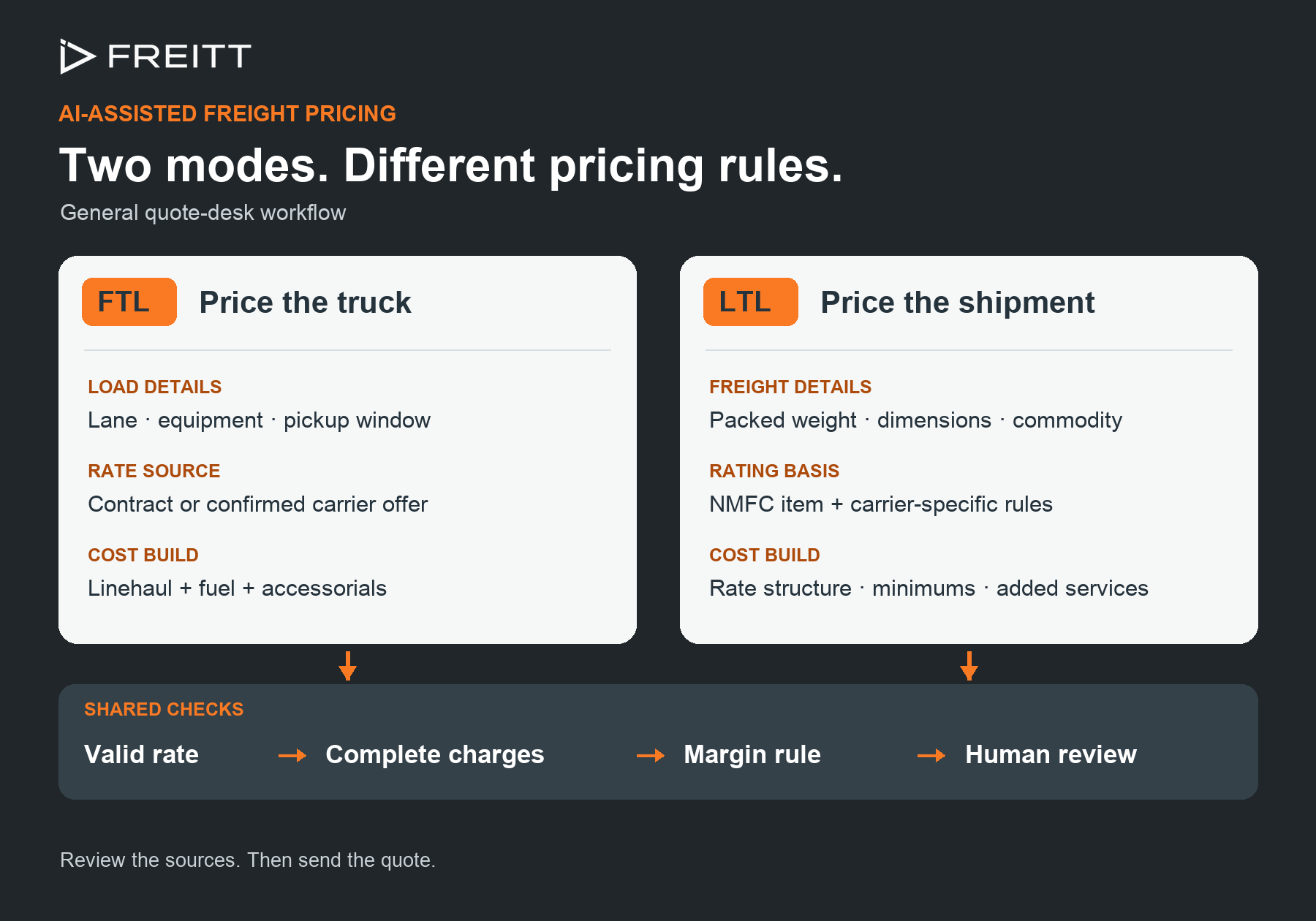
General workflow: FTL and LTL follow distinct rating rules, with shared checks before a quote is sent.
The controls that make automated quotes dependable
Check dates and charge inclusions
Rate validity should cover the intended shipment under the agreement, rather than merely the day someone uploads a spreadsheet. Store the source, currency, equipment, geographic coverage, and effective period with each rate. If two sheets overlap, resolve their precedence before generating a customer draft.
Fuel also needs its own check. EIA publishes diesel price data, while carriers apply their own surcharge schedules and effective dates. Use the governing schedule and calculation basis; a fuel percentage applied to linehaul is different from a surcharge applied to the entire invoice.
Keep uncertainty visible
A practical review screen should show the original request beside extracted fields, calculated charges, and assumptions. If an attachment says pounds while the email says kilograms, stop for clarification. Missing information and missing rates need separate flags because they require different follow-up actions.
For predictable repeat freight, approved rules can speed preparation. For unusual equipment, incomplete classification, thin margin, or an uncertain carrier offer, route the quote to someone who can resolve the exception. Record any override and its reason so the next operator can understand the decision.
Measure accuracy after the load moves
During rollout, compare prepared quotes with reviewed quotes, booked carrier costs, and final invoices. Track preparation time, correction frequency, missing-charge incidents, and realized gross margin. Separate changes caused by incorrect inputs from legitimate changes in service. This gives the team concrete evidence about where automation helps and where its rules need revision.
How Freitt helps trucking quote desks
Freitt’s published road-freight workflow reads load requests, selects applicable rates, adds listed fuel and accessorials, and prepares a traceable draft. It supports rate sheets organized by named lane, postcode zone, or distance band, with equipment and minimum-charge checks.
Its email-to-quote feature reads requests and attachments, helping teams carry shipment details into the quoting process. Rate-sheet automation maps existing Excel layouts, excludes expired lines, and links charges to their source sheet, row, validity, and applied rule.
Customer, lane, and mode margin rules, plus approval routing, are Growth-plan capabilities. These controls help teams apply agreed pricing consistently and escalate exceptions. Freitt drafts the quote; a person reviews and sends it.
For FTL workflows based on agreed sheets, this supports repeatable quoting. For U.S. LTL, confirm the specific NMFC, tariff, weight-break, and carrier-rating requirements during evaluation: Freitt’s public road documentation does not establish a complete U.S. LTL classification engine or live spot-market pricing service.
When no valid rate exists, Freitt flags the gap and drafts a carrier inquiry. Bring an FTL request and a representative LTL request to a demo, with the governing sheets and expected totals, to verify the exact workflow your desk needs.
FAQs
Can AI guarantee the lowest freight price?
No. It can organize evidence and apply rules consistently. Available capacity, carrier acceptance, service requirements, and changing market conditions still influence the final price.
Is LTL simply a fraction of an FTL rate?
No. LTL uses carrier-specific network pricing and shipment characteristics. Dividing a truckload price by the number of pallets can miss minimums, classification, and service charges.
What happens when information is missing?
The desk should request clarification or hold the quote. Unknown dimensions, equipment, or accessorial requirements should remain visible until resolved.
Does Freitt replace a TMS?
No. Freitt says it works alongside existing transport management systems, spreadsheets, and email. Its role is preparing quotes from approved inputs and rules, while your team retains review and sending responsibility.