
Guide11 min read
Freight Quote Automation: The Complete Guide for Freight Forwarders
Learn how freight quote automation works, how software handles RFQs and rate sheets, and how to improve quoting speed, accuracy, and profitability.
Oct 9, 2026
A busy inbox should not decide which shipments you win. See how Freitt helps small forwarding teams prepare quotes, apply pricing rules, and keep customer decisions in human hands.

A customer sends a rate request before lunch. The shipment looks straightforward, but the dimensions are in an attachment, the applicable rate is in another workbook, and the person who knows the customer’s pricing agreement is on a call.
Before your team can discuss the customer’s deadline, someone has to assemble a quote.
For a small freight forwarder, that work competes with everything else: following up on open opportunities, checking a difficult shipment, or calling a customer whose plans have changed. Each request may be manageable on its own. A queue of them can consume the day.
AI freight quoting offers a practical way to reduce that workload. Freitt is built for small forwarding teams that want help turning incoming requests into quotes while keeping control of their rates and customer relationships.
Key takeaways
Quoting is a practical place to begin with AI: it connects a repetitive daily task to a customer’s buying decision.
Freitt prepares quotes using your own rates and supports human review before sending.
Faster replies need reliable inputs, clear pricing rules, and someone accountable for exceptions.
Measure response time, corrections, wins, and margin together to judge whether automation is helping.
Recent market data shows why a single story about falling rates or excess capacity is too simple. In its September 29, 2026 release, IATA reported that global air cargo demand rose 4.4% year over year in August, while available capacity fell 0.1%. That is an air cargo snapshot, but it illustrates the changing conditions a quoting team must work within.
Forwarders also face pressure from customers. Descartes’ 2025 Forwarder/Broker Benchmark Study surveyed 434 freight forwarders and customs brokers. Customer pricing pressure was cited by 61% as a significant challenge expected over the next five years, while 25% identified manual workflows as the leading obstacle to growth. The results were released in November 2025.
Our practical reading of these findings: a forwarder needs a process that can respond promptly and explain its price. Moving quickly is useful only if the quote reflects the correct shipment, an applicable rate, and the commercial terms the business intends to offer.
That makes quoting a useful starting point for AI. It has a clear input, a reviewable output, and a customer response you can measure.
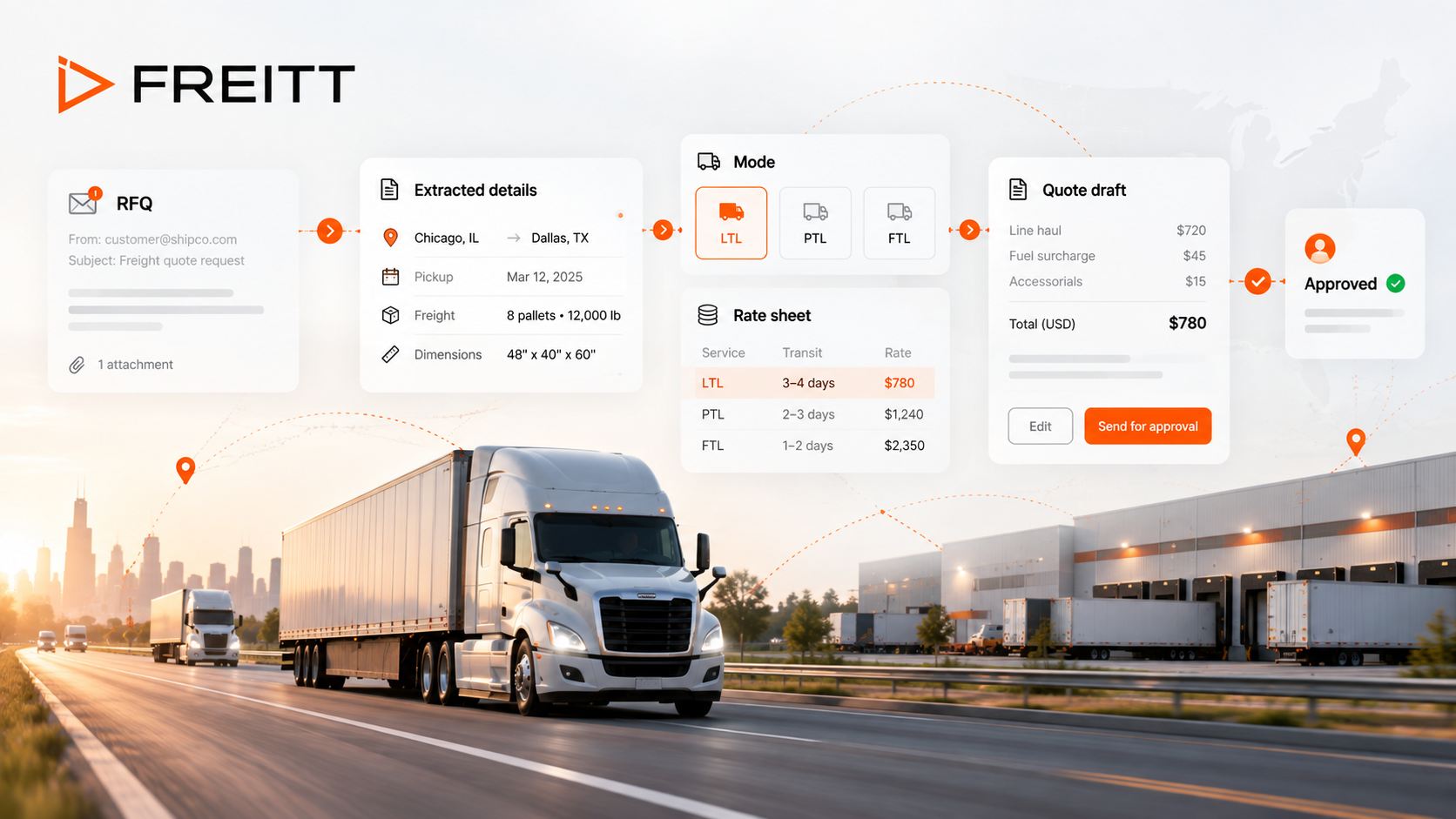
Freitt’s email-to-quote workflow reads forwarded RFQs and supported attachments, including PDFs, spreadsheets, Word documents, and images. It structures shipment information so the team can check the request before pricing it.
The benefit starts with less retyping. A rep can spend more attention on what the customer needs and whether the request is complete. If a delivery deadline is unusually tight or the shipment needs special handling, that deserves a conversation.
Freitt also flags uncertain fields and can draft a clarification when essential information is missing. Your team reviews the original request alongside the extracted details and priced draft.
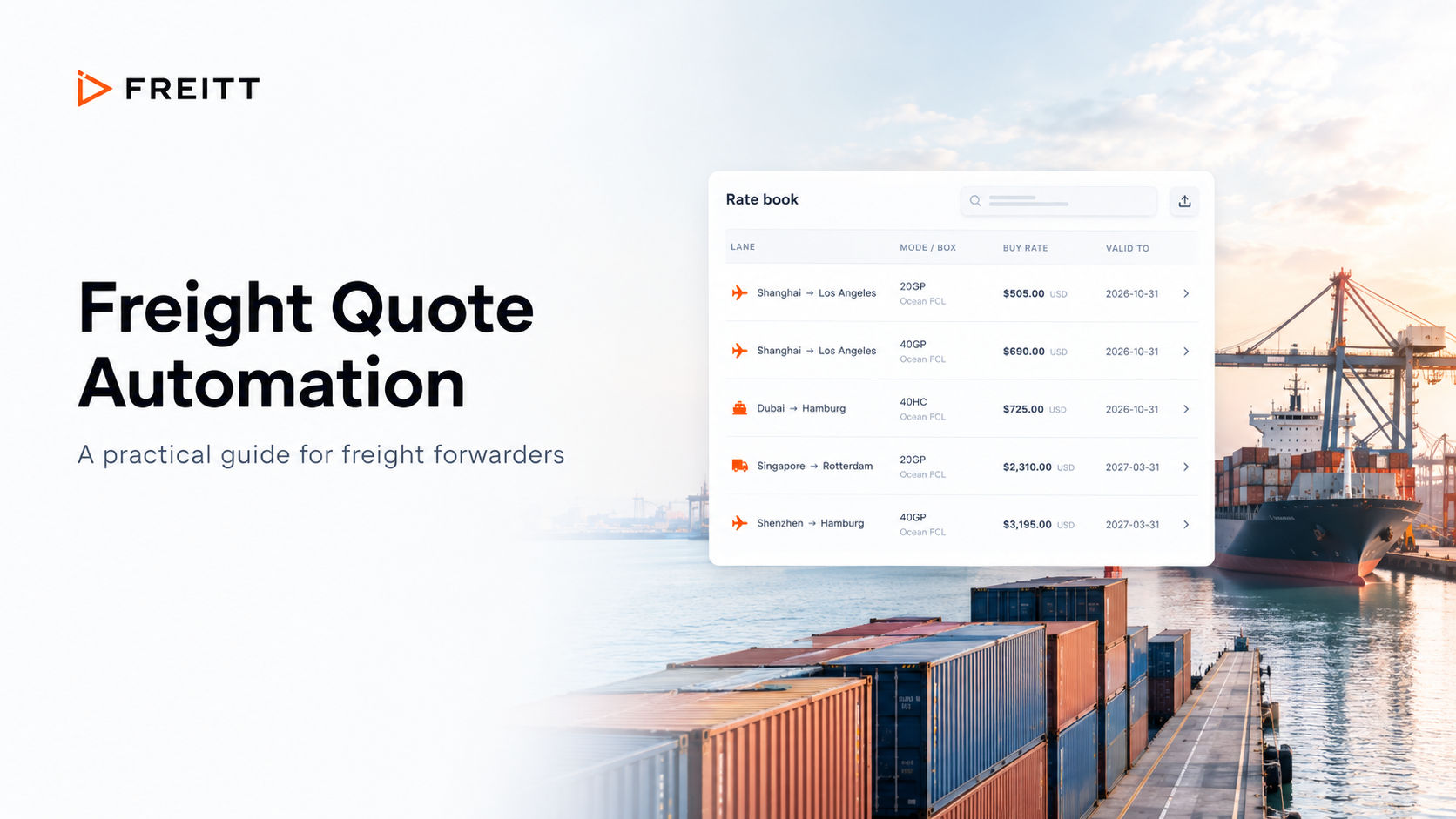
Rate accuracy matters as much as response speed. Freitt’s rate-sheet automation maps existing Excel sheets, matches requests to valid rate lines, and excludes expired rates. Charges remain traceable to their source. If no valid rate is available, it flags the gap and prepares a carrier inquiry.
This gives the reviewer a concrete question to answer: does this rate apply to this shipment? It also makes it easier to investigate a disputed figure without reconstructing the quote from memory.
Your team still needs to maintain the underlying rate book. A carrier’s revised charges must reach that source before they can reliably inform a quote. Treat keeping rates current as an assigned responsibility in the workflow.
An attractive quote needs to make commercial sense for the forwarder too. Freitt supports pricing rules by customer, lane, and mode, with approval routing for exceptions such as high-value or low-margin quotes. Its published product page identifies these margin and routing capabilities as Growth-plan features.
That helps turn a pricing policy into a repeatable process. Managers can decide which exceptions need attention, and reviewers can see which rule was applied.
Agree those rules before automating them. Make sure everyone understands the difference between a markup on cost and a gross-margin target, who can authorize a discount, and which charges the quoted price includes. Software needs a clear policy to apply.
Freitt works alongside existing email, spreadsheets, and a TMS. The current workflow uses email forwarding; native Gmail and Outlook connections are listed as coming soon. A person reviews and sends the customer quote.
That review is where freight expertise earns its place. A rep may know that a customer values certainty over the lowest price, or that an apparently routine request needs a call before a commitment. Reducing preparation work gives the team more room for those decisions.
Freitt’s quote tracking and analytics covers measures such as time to draft, time to send, drafts sent without a pricing edit, and wins and losses by lane or customer. It also surfaces margin exceptions and open follow-ups.
Use those measures to diagnose the process. Quick drafts followed by slow sends suggest a review bottleneck. Frequent pricing corrections point toward rate mapping or rule problems. Fast responses with weak conversion call for a closer look at price, service, and the opportunities being pursued.
Measure the result your customer experiences, then investigate what causes it.
AI adoption works better when the team can inspect the results. Descartes’ 2026 Transportation Management Benchmark Survey identifies data quality as the biggest barrier to scaling AI and reports that fewer than one in five organizations use it at scale. This is a broader transportation survey, rather than a Freitt performance study.
For a forwarding team, a sensible first test is a familiar lane with a maintained rate sheet. Include the people who prepare quotes, approve exceptions, and follow up with customers.
Record a baseline: how long requests wait, how much hands-on work they require, and how often quotes need correction.
Test ordinary requests and difficult ones, including missing dimensions, expired rates, and customer-specific pricing.
Review corrections with the team and fix the source data or pricing rule responsible.
Compare response time and accuracy first. Evaluate conversion and realized margin over enough completed shipments to make the comparison useful.
Time savings can make the business case tangible. As an illustration, saving eight minutes on each of 40 daily RFQs would free 320 minutes, or five hours and 20 minutes, across the team. This is a calculation using hypothetical inputs, not a measured Freitt result. Subtract ongoing review and maintenance effort, and use your own quote volume and observed savings.
Decide where that recovered time should go. Following up on a promising quote, preparing a better service option, or resolving an exception can be more valuable than simply producing more drafts.
A strong quote makes the next decision easier for the customer. It arrives while the opportunity is active, explains the offer clearly, and reflects a price your team can stand behind.
Freitt can help with the preparation that makes that possible. Start with an actual request and assess the draft, its source rates, and the checks your team needs before sending.
Book a Freitt demo and bring one RFQ with its matching rate sheet. Walk through the workflow using the work your team already does.
It uses AI to interpret a freight request and prepare the information needed for a quote. Freitt combines that with your approved rates and pricing rules to produce a draft for human review.
Freitt lists air, ocean, and road freight, with rating methods appropriate to each mode.
Freitt’s rate-sheet workflow uses your own mapped spreadsheets. Its product page directs businesses needing live spot rates or market benchmarking to a different category of tool.
The published current workflow requires a person to review and send. Opt-in auto-send is listed as coming soon.
No. Price, capacity, service, timing, and customer relationships all affect a booking decision. Track conversion and margin alongside response time to understand whether the change is helping your business.
Want to see this run on your own lanes? Bring one RFQ and the matching rate sheet to a 30-minute live quote session.
Learn how freight quote automation works, how software handles RFQs and rate sheets, and how to improve quoting speed, accuracy, and profitability.
Oct 9, 2026
Learn how an AI quote desk can simplify trucking quotes by reading RFQs, applying your own rates, checking FTL, LTL and PTL requirements, and preparing accurate quotes for human approval.
Oct 4, 2026
An AI rollout only works once your team trusts its output enough to send it to a customer. Here's how to bring AI into the freight quote desk with a clear review standard, a tight pilot, and measurement that shows what's actually changing.
Sep 30, 2026
See it live
Bring one rate request and the matching rate sheet. We’ll show you how Freitt reads it, prices it and drafts the reply.
30 minutes · no deck · your rates stay private