An AI rollout becomes real at the moment someone has to trust its work enough to use it on a customer request.
For a freight team, that moment might be a quote with an unfamiliar surcharge, a shipment with incomplete dimensions, or a rate that expires before the cargo is ready. The person reviewing it needs to know where the information came from, what has been checked, and what still needs a decision.
That is where leadership matters. Give people a clear way to inspect the work, handle exceptions, and see whether the new process helps them. The rollout then has something practical to build on.
Here is how to bring AI into your freight operation, starting with the quote desk.
Key takeaways
Set the review standard first. Agree on what a person must verify before a quote reaches the customer.
Start with a defined workflow. Choose familiar lanes, current rates, and clear ownership for review and exceptions.
Test difficult requests early. Missing details, expired rates, and changed instructions should be part of the pilot.
Measure the whole process. Track preparation, review, corrections, and customer response time separately.
Use analytics to guide improvements. Freitt’s upcoming dashboard will help teams examine quoting activity; expand based on what your own workflow shows.
Define what a usable quote looks like
Before choosing your first workflow, agree on what the team must be able to verify at the end of it.
A usable draft needs more than a total. The reviewer should be able to check the shipment scope, rate validity, charging basis, applicable surcharges, and customer terms. They also need to know what is missing.
Turn those requirements into a short acceptance checklist. Ask an experienced operator to review it against a few recent requests. If they normally check something that the checklist misses, add it before the pilot begins.
This makes the team’s expertise part of the rollout. It also gives you a better question than “Did the AI produce a quote?” You can ask whether it produced a draft that a person could confidently review.
Give the pilot a clear boundary
Choose one service or group of lanes with a maintained rate sheet, a familiar quote format, and enough incoming requests to learn from. Write down which requests belong in the pilot and where the others should go.
Assign three responsibilities: someone owns the rates, someone reviews the drafts, and someone resolves questions the reviewer cannot settle. One person may hold more than one role in a small team. Each responsibility still needs an owner and cover for absences.
That last detail matters. A draft waiting for an unavailable approver can leave the customer waiting just as long as the old process did.
Freitt’s quoting workflow provides a starting point: forward a request, check the extracted details, review pricing prepared from your rate sheets, and send the response from your own email. Your team keeps the decision about what reaches the customer.
Test the awkward requests before expanding
A routine request tells you whether the process can work. An awkward one tells you what the team will need when it does not go smoothly.
Include these cases in your pilot:
Incomplete shipment details. Can the reviewer identify what must be clarified before pricing?
An expired or missing rate. Is the gap visible, and who obtains a replacement?
A changed request. Does the final draft reflect the latest shipment details and service scope?
An unusual commercial decision. Does the reviewer know when to involve a manager?
Freitt flags missing valid rates and drafts a carrier inquiry. Build the human follow-through into your process: who checks the inquiry, who sends it, and who returns to the quote when the answer arrives.
Keep a brief record of corrections and their causes. A repeated charge error may call for a rate-sheet fix. A recurring scope question may call for a clearer review checklist. Treat each finding as a specific piece of work to resolve.
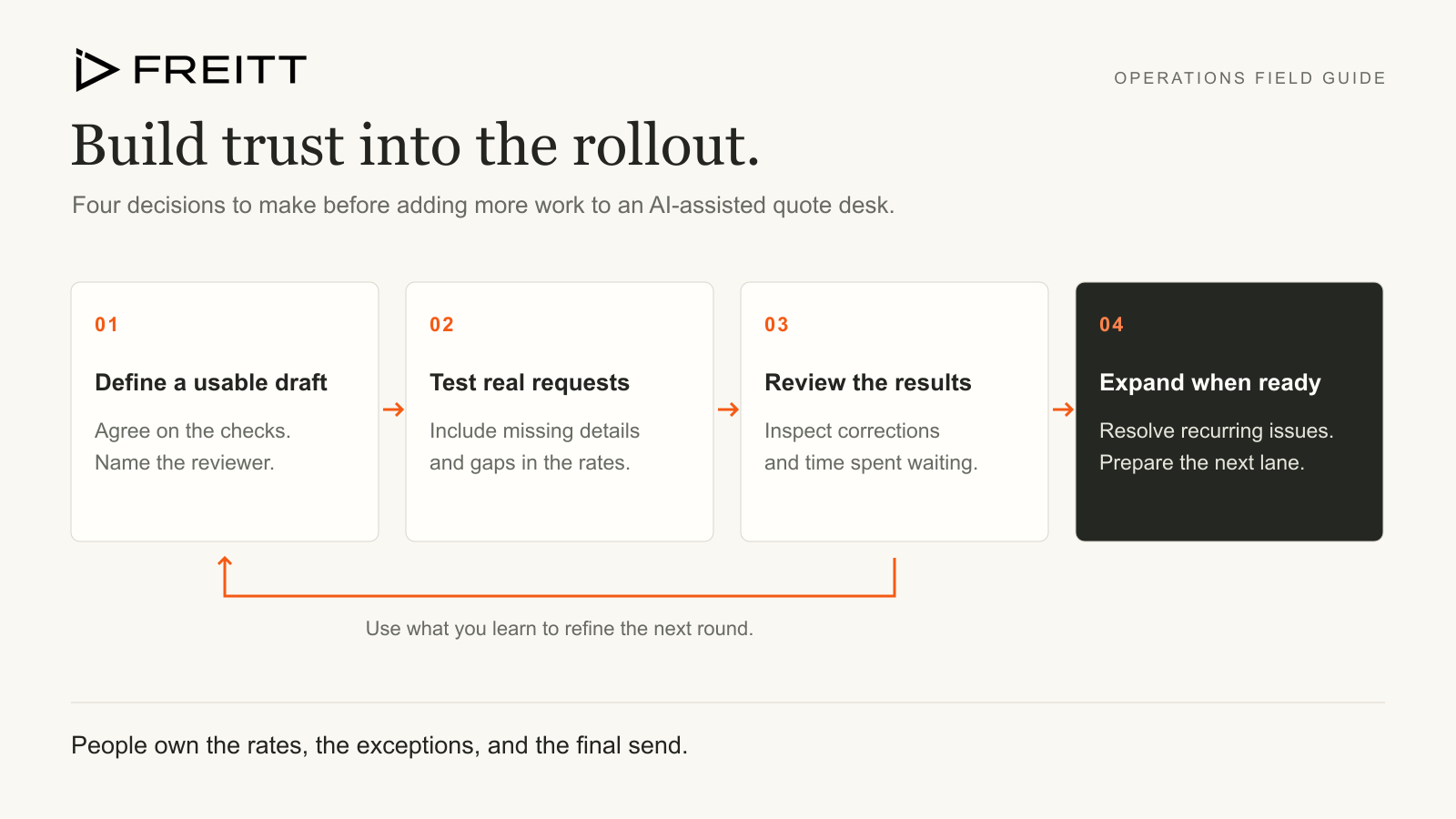
Use the pilot to settle ownership, exceptions, and review standards before adding more work.
Make the review queue part of the rollout
Automation changes where people spend their attention. If preparation becomes faster, more drafts may reach review together. Plan for that handoff.
Agree on how reviewers will find pending work and how urgent requests will be distinguished from routine ones. Check whether the person covering the queue has enough time to read the source request, inspect the charges, and resolve uncertainties.
During the pilot, review a handful of completed quotes together. Ask the operator to show which checks were straightforward and where they had to reconstruct the work. The answer can reveal an unclear procedure that a training presentation would miss.
Make it easy to flag a doubtful draft. A correction caught before sending is useful information about the workflow. Record it, fix its cause, and use a similar request to check the fix.
Use analytics to choose the next improvement
Once requests are moving through the process, look at where they pause and what happens after the quote goes out.
Freitt’s analytics dashboard is scheduled to become available to customers on October 1, 2026. The planned analytics experience includes visibility into quote turnaround, pricing edits, responses, and outcomes, helping teams examine their own quoting activity.
Use that visibility to guide a regular review. Start with a question the team can act on:
Are drafts ready but replies still delayed? Check the review queue, approval coverage, and unresolved questions.
Are the same charges being corrected repeatedly? Inspect the source rates and pricing setup with the person who maintains them.
Are sent quotes waiting for a response? Decide which need follow-up and give each one an owner.
Keep customer response time separate from the time people actively spend working. A faster draft does not tell you how much effort the reviewer used or when the customer received the reply. Maintain a simple pilot log for details your reporting does not capture.
Compare similar request types over a defined period. A change in the mix of lanes or shipment complexity can affect results. Keep unknown outcomes separate from confirmed losses, and investigate the underlying quotes before attributing a change in win rate to AI.
Expand when the team can explain the process
Before adding another lane or service, ask the team to walk through a request from arrival to reply. They should be able to explain the source of the price, the checks before sending, and what happens when something is missing.
Review the pilot’s corrections and delays. Confirm that the recurring issues have owners and that the next group of requests has suitable rates and review coverage. Then carry those lessons into the next stage.
Frequently asked questions
Where should a small freight team start with AI?
Start with a repeatable task that has clear inputs and a result someone can check. For quoting, choose a familiar service or group of lanes, a current rate sheet, and an agreed review checklist. Include both routine requests and exceptions before expanding.
Does Freitt replace our existing email or TMS?
Freitt works alongside your email, spreadsheets, and transport management system. Requests reach Freitt through email forwarding. Its FAQ lists native Gmail and Outlook connections as upcoming, so plan your initial workflow around forwarding.
Who approves and sends quotes prepared by Freitt?
A person on your team reviews the draft and sends the customer response from your own email. Freitt prepares the quote using your rate sheets and configured pricing rules. Your reviewer remains responsible for checking the scope, charges, terms, and any unresolved questions. See the workflow.
What happens if Freitt cannot find a valid rate?
Freitt flags the gap and drafts a carrier inquiry instead of inventing a price. Your team reviews and sends the inquiry, obtains the missing information, and checks the resulting quote before it reaches the customer. Read Freitt’s quoting FAQ.
How should we measure whether AI is helping?
Compare similar requests before and during the pilot. Record active handling time, elapsed time until the customer receives a reply, corrections, and unresolved exceptions. Track outcomes when known, but investigate changes in request mix and commercial conditions before attributing a change in wins to AI.
When will Freitt’s analytics dashboard be available?
Customer availability is scheduled for October 1, 2026. The planned dashboard includes visibility into quote turnaround, pricing edits, responses, and outcomes. Use those measures alongside the team’s review notes to decide what to improve next.
Start with one of your own requests
Freitt gives you a concrete place to begin: your own RFQs, rate sheets, and quote format. Bring a recent request and its matching rates to a live Freitt demo. Walk through the resulting draft with the person who would actually review it. Their questions are the starting point for your rollout.