Trucking quotes can look simple from the outside: identify the route, check the rate and send the customer a price.
In practice, there is much more happening behind every quote.
A freight forwarder may need to identify whether a shipment should move as FTL, LTL or partial truckload, find the correct carrier rate, apply minimum charges, calculate fuel, check accessorials, account for carrier-specific rules and then add the correct customer margin.
When quote volumes increase, this becomes one of the easiest places for freight teams to lose both time and margin.
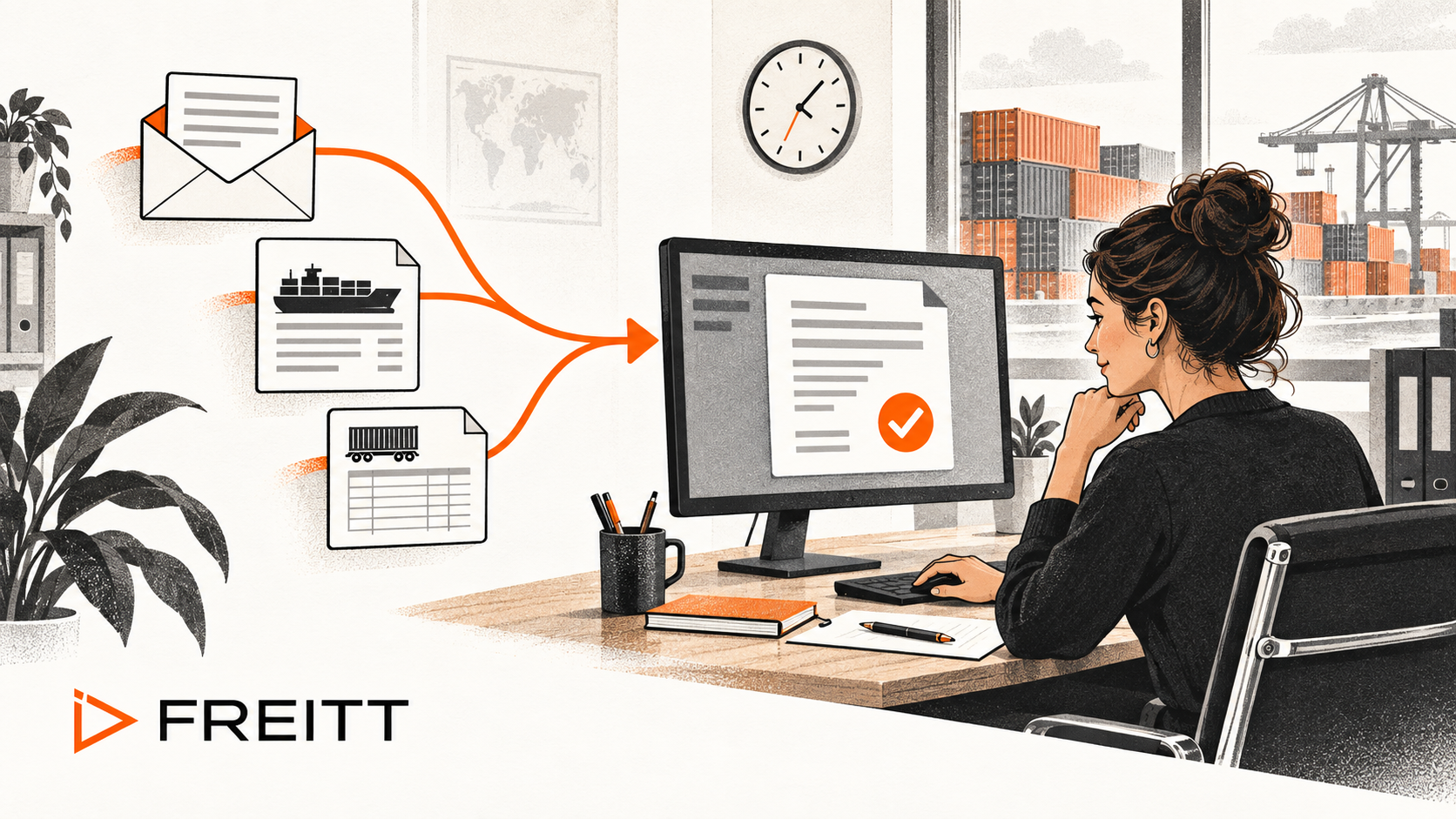
An AI quote desk helps automate much of this process. Instead of manually reading every RFQ and searching through spreadsheets, emails and carrier rate sheets, AI can extract the shipment information, identify the relevant pricing rules and prepare a quote for review.
The important part is that automation should support the person making the decision, not replace their judgement.
Key takeaways
An AI quote desk reads freight quote requests, prices them from your rate sheets and drafts a quote for a person to approve.
In trucking, accuracy depends on choosing the right mode: FTL (full truckload), LTL (less than truckload) or PTL (partial truckload).
Most trucking quote errors come from missing shipment details, forgotten accessorials and carrier rules, not from bad base rates.
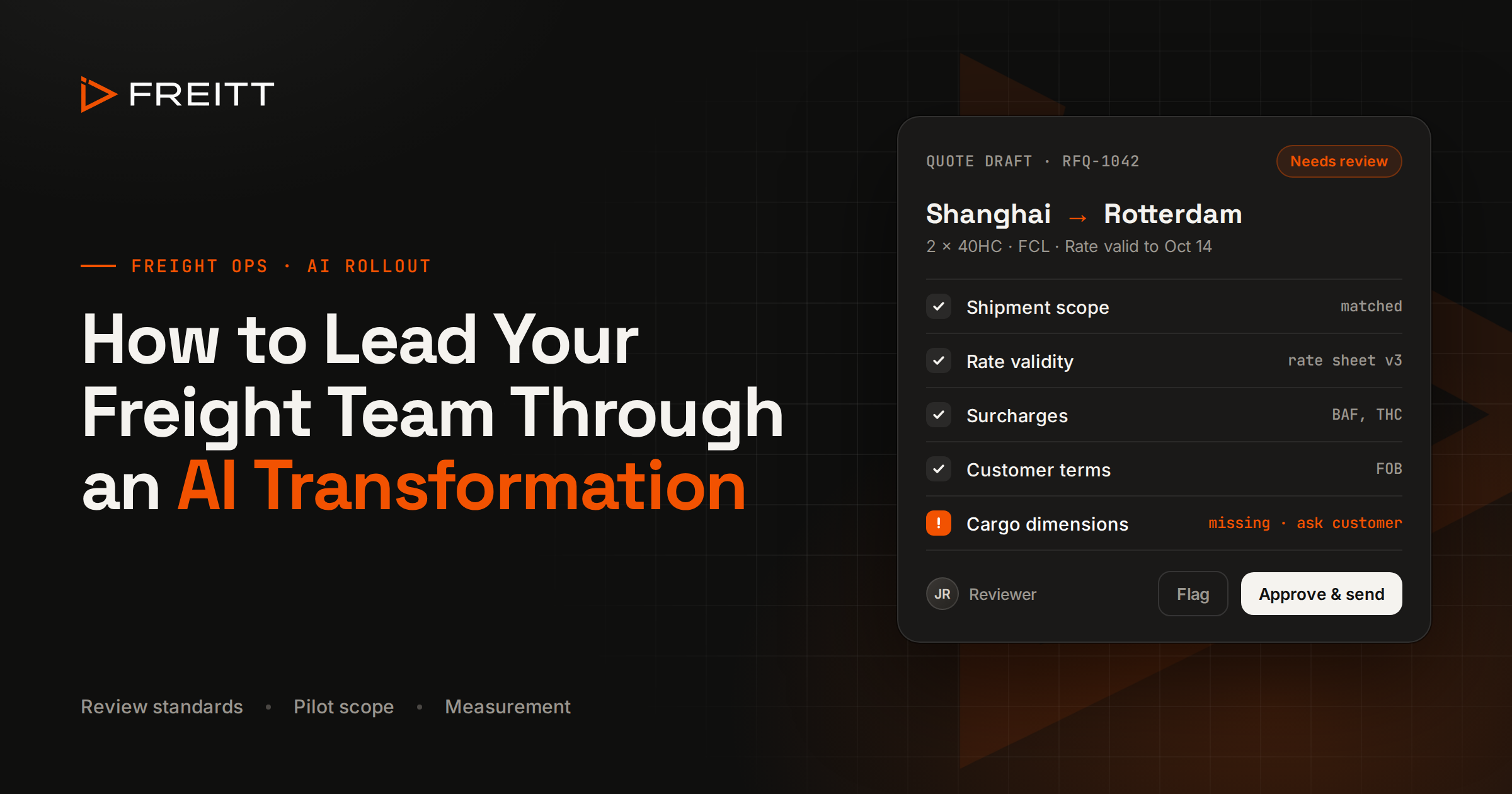
A good AI quote desk shows its working, flags missing rates instead of guessing, and never sends a quote without human approval.
AI can reduce repetitive quote-desk work while allowing freight professionals to remain in control of pricing decisions.
What is an AI quote desk?
An AI quote desk is software that turns a freight quote request into a priced, ready-to-send quote. It reads the request, extracts the shipment details, applies your rates and margins, and drafts the reply. A person reviews and sends it.
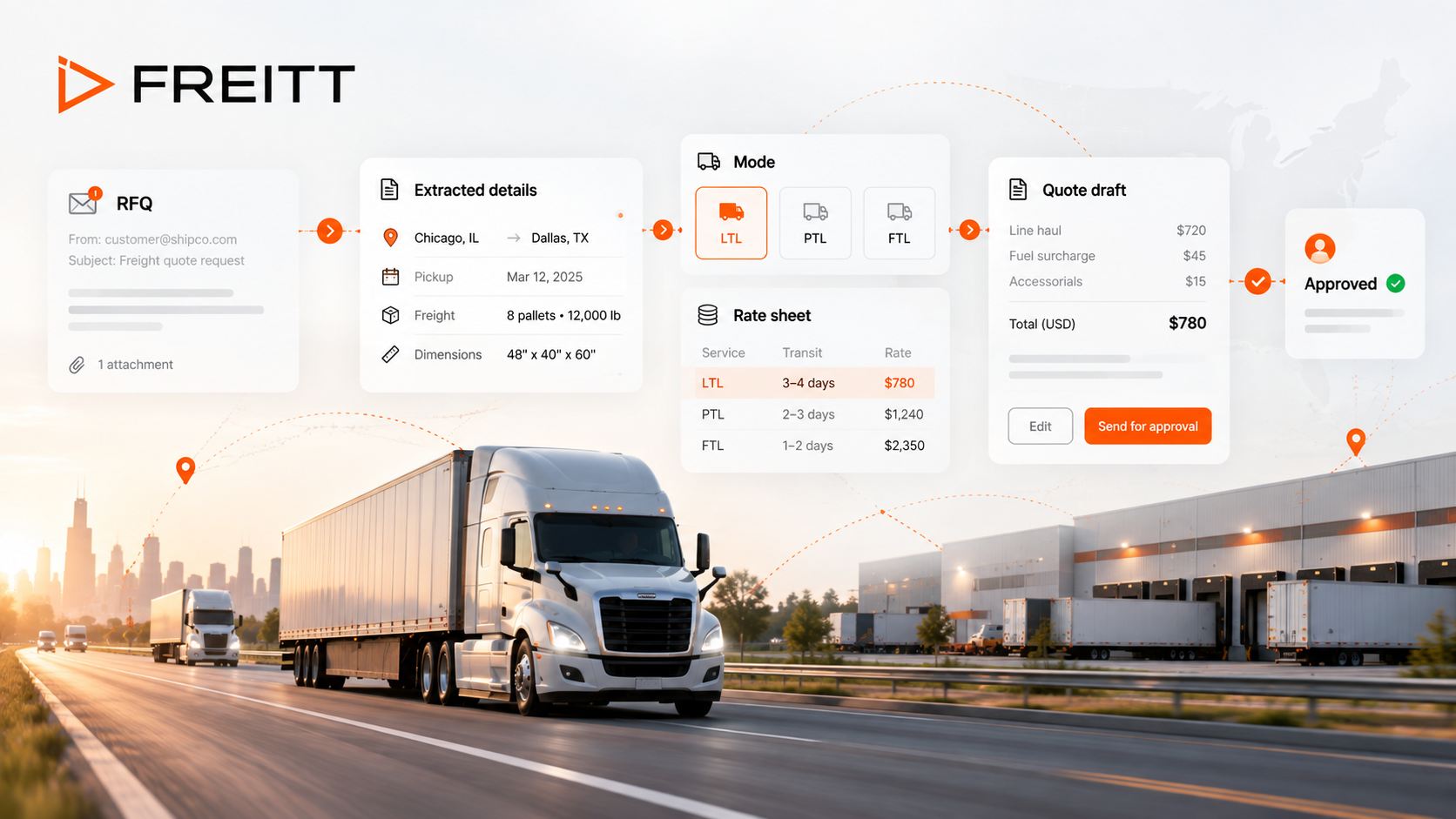
For a trucking or road freight quote, the workflow usually runs like this:
Request arrives. A customer emails an RFQ, often with a spreadsheet or PDF attached.
Details are extracted. Collection and delivery points, pallet count, dimensions, weight, dates and service needs.
Equipment and mode are set. The AI works out what vehicle and service the load needs.
The rate is found. It looks up the matching lane, zone or distance rate in your haulier rate sheets.
Charges are added. Minimum charges, fuel surcharge, accessorials and your margin.
A draft is prepared. The quote shows each charge and where it came from.
A person approves and sends it.
Why trucking quotes are slow and loses margin
Manual trucking quotes are slow because every request means reading an email, finding the right haulier sheet, checking minimums, adding fuel and remembering the accessorials. Industry estimates put manual freight quoting at 2 to 4 hours per request. Slow quotes lose shipments.
They leak margin because small misses add up on the carrier invoice:
Forgotten accessorials. Liftgate, residential delivery, limited access sites and appointments are rarely in the RFQ, but they are always on the bill.
Missed minimum charges. Short lanes priced per mile or per pallet can fall below the haulier's minimum.
Density and class changes. In US LTL, the 2025 NMFC changes moved most freight to a 13-tier density scale, so a few extra inches of pallet height can raise the class and the price.
Capacity rules. Light, bulky LTL shipments can trigger cubic capacity or linear foot rules that replace the normal rate.
Stale fuel and rates. Fuel surcharges move with the weekly diesel price, and rate sheets expire.
FTL vs LTL vs PTL: what an AI quote desk must understand
The three trucking modes are priced on different inputs, so the mode decides the price. FTL is the trucking equivalent of an ocean FCL (full container load), and LTL is the equivalent of ocean LCL (less than container load).
| LTL | PTL (partial or volume LTL) | FTL |
Typical size | 1–6 pallets, under ~5,000 lb | ~6–18 pallets, ~5,000–25,000 lb | A full trailer or a time-critical load |
Handling | Shared trailer, moves through terminals | Stays on one truck | One truck, door to door |
Priced on | Freight class, weight, origin and destination | Linear feet, pallet count, weight | Lane, distance, equipment |
Main risk | Reweighs, reclasses, missed accessorials | Priced as LTL and hit by linear foot rules | Detention, layover, extra stops |
Thresholds vary by carrier. When a load sits near a boundary, the best answer is to price more than one option.
Example: 8 pallets at 48×40×60 inches and 900 lb each is 7,200 lb and about 16 linear feet of trailer floor. Priced from a standard LTL tariff, it may trigger a linear foot rule. Quoted as PTL or a dedicated truck, it is often cheaper and safer.
The rate sheet data an AI quote desk needs
An AI quote desk can only be as accurate as the rate sheets behind it. For trucking, one lane-rate table is not enough. Structure your data so each part of the price has its own place:
Data | What to include |
|---|
Lane rates | Origin, destination (zone, distance or named lane), equipment, rate basis, minimum charge, transit days, validity dates |
LTL pricing | Base tariff, discount %, freight-all-kinds (FAK) class agreements, absolute minimum charge, weight breaks |
Partial loads | Linear feet or pallet range, max weight, stackable Y/N, rate basis |
Fuel surcharge | Diesel index used, price bands, surcharge % or rate per mile, effective day |
Accessorials | Fee name, charge type, rate, free time, when it applies |
Carrier rules | Cubic capacity, linear foot and overlength triggers and how they are charged |
Margins | Customer, mode, markup, minimum margin, approval threshold |
Final thoughts
Trucking quotes rarely become unprofitable because someone cannot calculate a base transportation rate.
The problems usually appear in the details.
It might be the liftgate that was never mentioned, the minimum charge on a short lane, an outdated fuel surcharge or a pallet that occupies more trailer space than expected.
Individually, those issues may look small. Across hundreds or thousands of quotes, they can have a significant effect on margin.
This is where AI quote-desk software can make a meaningful difference.
Modern tools can take over much of the repetitive reading, data extraction, rate searching and calculation involved in freight quoting while still leaving the final decision with the person responsible for the quote.
Platforms such as Freitt, for example, are designed around this type of workflow: using a company's own freight rates to help prepare air, ocean and road quotations while keeping people involved in the approval process.
For freight businesses, the goal is not necessarily to automate every decision.
It is to remove unnecessary manual work so that the quote desk can respond faster, reduce avoidable pricing mistakes and spend more time making the commercial decisions that actually require human judgement.
Frequently asked questions
What is an AI quote desk in trucking?
An AI quote desk is software that reads trucking quote requests, prices them from your haulier rate sheets and drafts a quote for a person to approve. It cuts quoting time from hours to minutes.
What is the difference between FTL, LTL and PTL?
FTL (full truckload) uses a whole trailer for one shipper. LTL (less than truckload) shares a trailer and moves through terminals, priced mainly by freight class. PTL (partial truckload) shares a truck but stays on it, priced mainly by linear feet and pallet count.
Why do trucking quotes lose money?
Most losses come from missed accessorials, minimum charges, fuel changes and carrier rules such as reweighs, reclasses and linear foot charges. An AI quote desk reduces these by applying every charge from the rate sheet and flagging missing details.
Can AI quote road freight from my existing rate sheets?
Yes. Freitt prices road freight from your own haulier sheets, whether they use zones, distance or named lanes, and shows the sheet and row behind every charge.
Does an AI quote desk send quotes automatically?
It should not. With Freitt, a person approves every quote before it is sent, and approval rules can hold large or unusual quotes.